How AI and Semantic Search Are Changing Resume Review
Recruiters can increasingly search for candidates using job descriptions, intake notes, and plain-English criteria. Learn what that means for your resume.
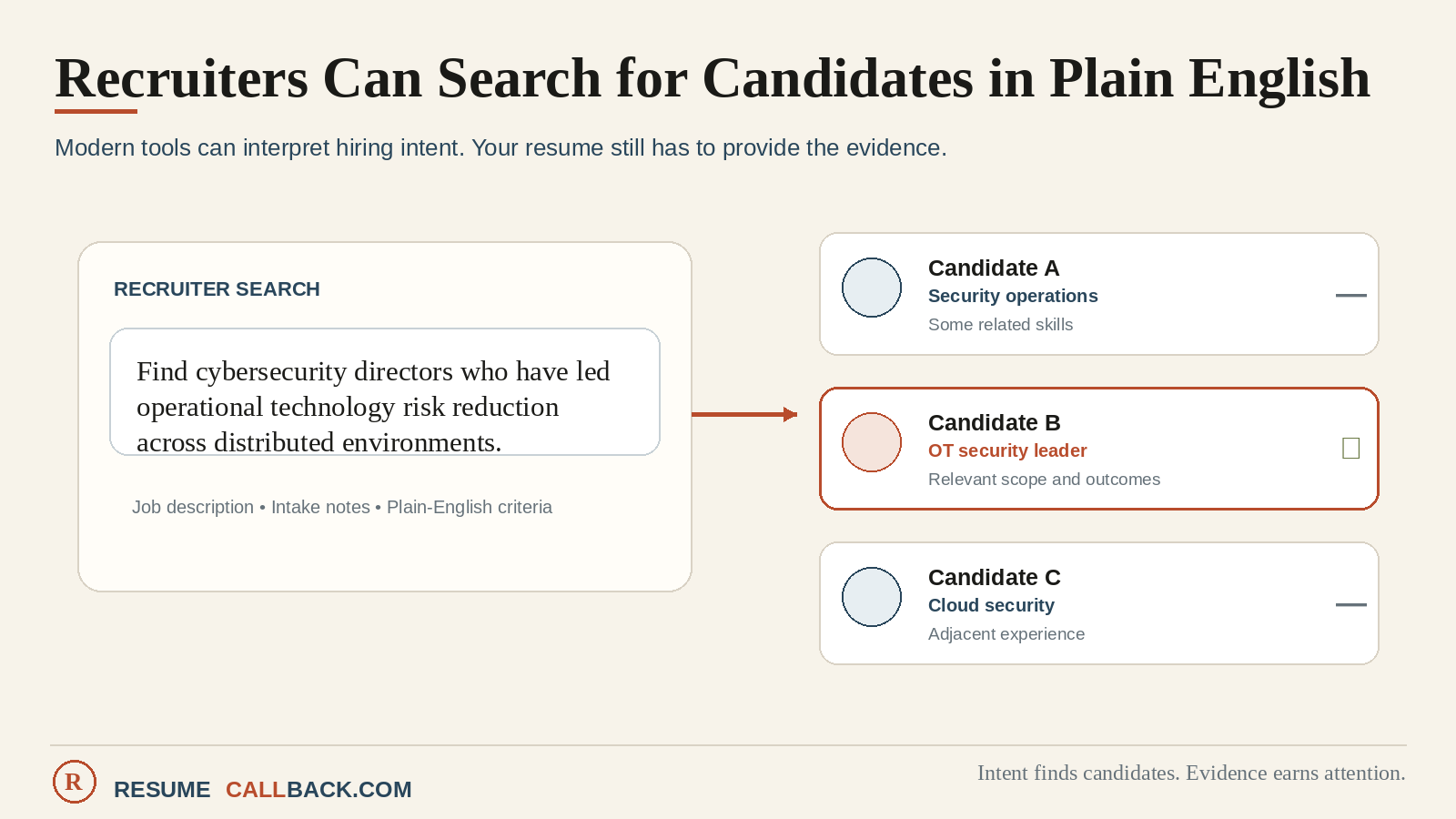
The traditional advice was simple: place the correct keywords in your resume so an applicant-tracking system can find them.
That advice is incomplete.
Recruiting platforms increasingly support searches that interpret job descriptions, intake notes, plain-English requests, related skills, and contextual qualifications. LinkedIn's Advanced AI-Assisted Search, for example, allows eligible Recruiter users to paste a job description or describe the candidate they need. The system identifies required and preferred qualifications and surfaces candidate profiles aligned with that intent.
Greenhouse describes AI-powered talent matching calibrated to employer criteria. Workday describes AI-assisted recruiting, candidate recommendations, and tools that highlight information relevant to a requisition.
This does not mean every employer uses the same technology. It does not mean AI universally decides who gets hired. It does mean that, in a growing number of workflows, the resume is evaluated as structured, searchable, and comparable evidence.
Keyword search and semantic search are different
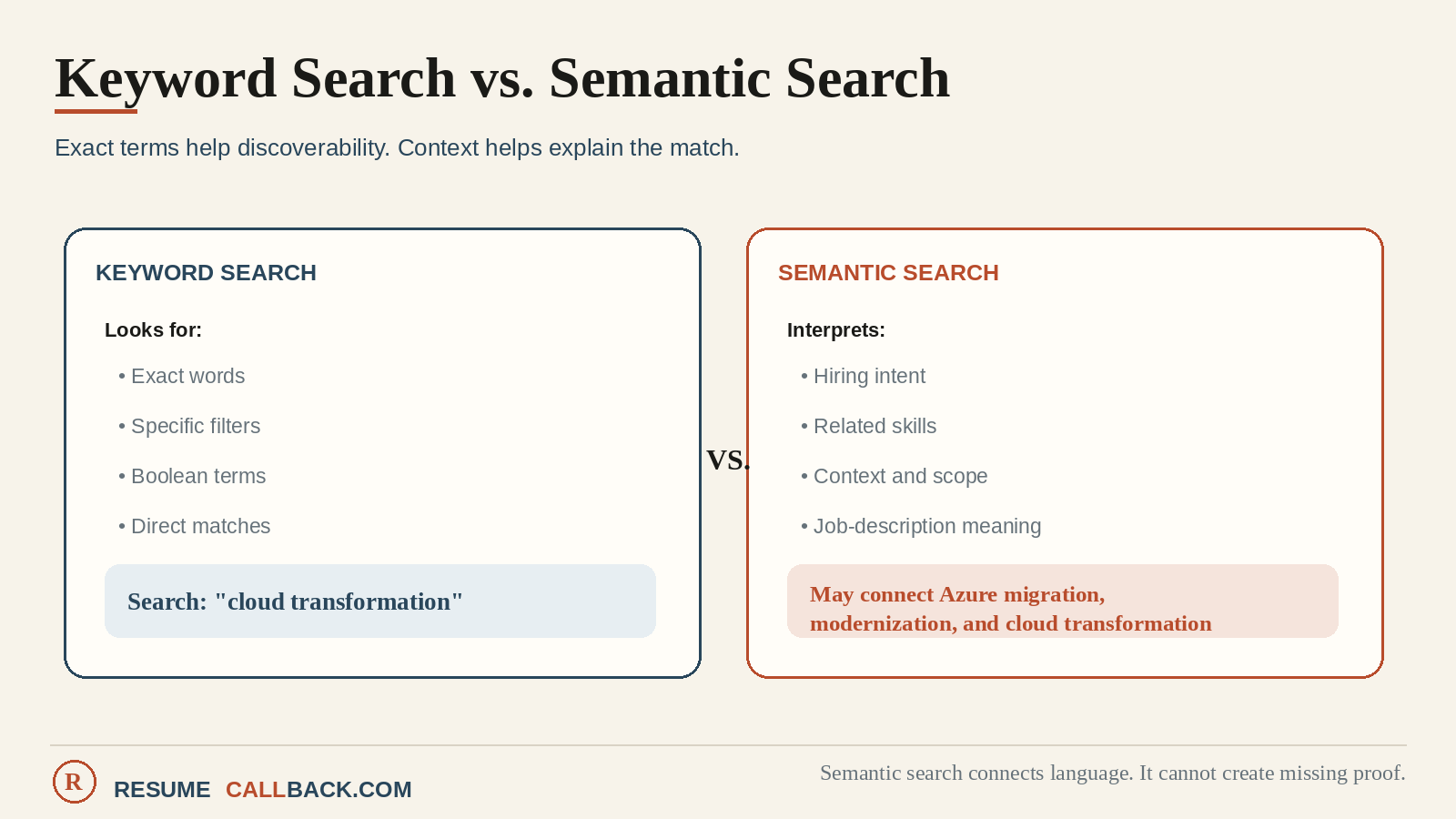
A basic keyword search looks for an exact word or phrase.
A semantic search attempts to interpret meaning, relationships, and context.
For example, a recruiter searching for someone who has led cloud transformation may surface candidates who describe Azure migration, data-center consolidation, platform modernization, or infrastructure transformation — even if the exact phrase "cloud transformation" is absent.
That sounds like good news for candidates. It can be.
It also creates a higher standard.
A modern system may understand that related terms belong together, but it cannot recover experience you never documented. It cannot confidently assume scope, ownership, or outcomes that are missing from the resume.
Semantic search reduces the value of exact-match keyword tricks. It increases the value of clear, contextual evidence.
Plain-English recruiting changes the search interface
Traditional recruiter searches often required complex filters and Boolean strings. Newer interfaces let recruiters describe the person they want.
Examples might include:
- Find infrastructure leaders who have supported distributed operations.
- Find cybersecurity directors with operational technology experience.
- Find program managers who have recovered delayed enterprise initiatives.
- Find candidates who have managed large technical teams and budgets.
The recruiter is not asking whether the resume contains one isolated keyword. The recruiter is expressing a hiring intent.
A candidate's resume must answer that intent with evidence. Which means the same conversation that used to be about "what keywords to include" is now about how clearly you can be found for the roles you actually want — the argument we make in Spray and Pray Is Not a Job-Search Strategy.
AI summaries can shape the first impression
Some recruiting products generate candidate summaries or fit explanations. These tools can help recruiters process large applicant pools and identify where qualifications appear to align with a role.
The important point is not whether every summary is correct. The important point is that the resume may be compressed into an initial explanation before a recruiter performs a detailed review.
If the strongest evidence is buried, vague, or missing, the summary cannot reliably manufacture it.
A generic statement such as "responsible for IT operations" provides little basis for comparison.
A stronger statement such as "led a 40-person infrastructure organization supporting 300 sites, eight data centers, and four operational-technology environments" provides role, scale, and context.
Searchable evidence has five parts
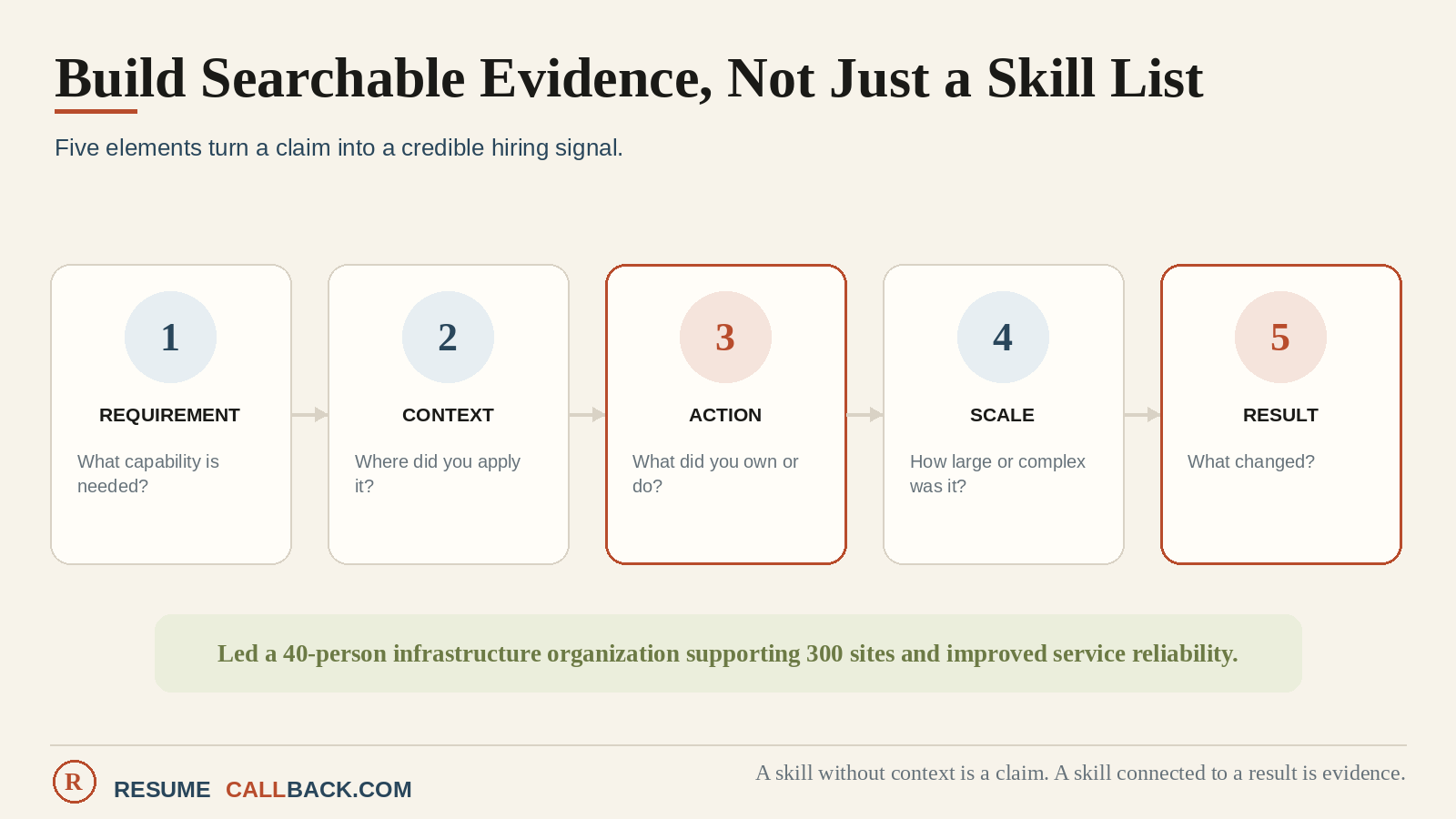
Strong resume evidence usually answers five questions:
- What capability was required?
- Where did you apply it?
- What did you personally own or do?
- What scale or complexity was involved?
- What changed as a result?
A skill list can help with discoverability. Accomplishment evidence helps with credibility.
"Azure" is a skill.
"Led the migration of critical enterprise workloads to Azure while maintaining service continuity" is evidence.
"Reduced recovery time by redesigning the backup and disaster-recovery architecture across private cloud and Azure" is stronger evidence because it adds a business outcome.
Before your next application: Analyze your resume against a job description to see the match score, missing evidence, and rejection risks.
The resume still needs a clear target
Semantic search does not eliminate the need for positioning.
A candidate with experience across infrastructure, security, cloud, operations, and consulting can legitimately qualify for several roles. A resume that attempts to emphasize every path equally may look broad but unfocused.
The system may identify many skills while remaining uncertain about the candidate's primary fit.
A targeted resume makes three things obvious:
- The role being pursued
- The relevant capabilities
- The evidence that proves those capabilities
Why keyword stuffing is weaker than evidence mapping
Candidates often respond to ATS anxiety by copying job-description language into the resume. This can produce awkward, repetitive writing and unsupported claims.
Modern matching tools are commonly described as interpreting qualifications and context, not merely counting repeated words. Exact implementation varies by platform, but the strategic response should be the same: use accurate employer language, then prove it.
Weak:
Risk management, compliance, governance, security strategy.
Stronger:
Established a risk-based cybersecurity roadmap that prioritized identity, vulnerability management, segmentation, incident readiness, and governance initiatives across the enterprise.
The stronger version maps the concepts to a real action.
A practical preparation method
For each serious job:
1. Translate the posting into hiring intent
Identify the problem the company is trying to solve. The answer may be growth, stabilization, modernization, risk reduction, compliance, program development, or operational recovery.
2. Identify mandatory and differentiating qualifications
Some requirements are baseline. Others distinguish strong candidates.
A certification may be mandatory. Experience leading a transformation at comparable scale may be differentiating.
3. Build an evidence map
Create a table with:
- Requirement
- Your matching experience
- Scope
- Outcome
- Resume location
Any critical requirement without evidence is a decision point: add truthful evidence, accept the gap, or reconsider the application.
4. Rewrite for clarity, not manipulation
Use terminology that accurately matches the employer's language. Do not claim work you did not perform.
5. Review what an automated summary might say
Ask: if a system reduced this resume to five sentences, would those sentences communicate the correct role, level, expertise, and outcomes?
What AI does not change
AI does not eliminate the need for human judgment.
Official product descriptions commonly position these tools as support for recruiter search, prioritization, or comparison. Greenhouse's public materials, including its Bias Audit Statement, describe recruiter oversight and transparency around automated matching. Workday and LinkedIn position AI as assistance to recruiting workflows.
Candidates should therefore avoid two extreme beliefs:
- "The system is only counting keywords."
- "The system perfectly understands my entire career."
Neither is a safe assumption.
The strategic conclusion
Your resume is no longer only a document written for a person. It is also a structured record that may be searched, interpreted, summarized, and compared before a detailed human review.
That does not require manipulation.
It requires disciplined communication.
State the target. Present the relevant evidence. Show scope and outcomes. Remove competing narratives. Use accurate language.
AI may help a recruiter understand related skills. It cannot supply the proof you failed to provide.
Before You Submit Your Next Application
ResumeCallback compares the resume and job description together so candidates can identify weakly supported requirements, missing evidence, and rejection risks before submitting the application.