Spray and Pray Is Not a Job-Search Strategy. It Is a Game of Luck.
Sending one generic resume to hundreds of jobs may create activity, but not alignment. Learn why targeted applications create more credible opportunities.
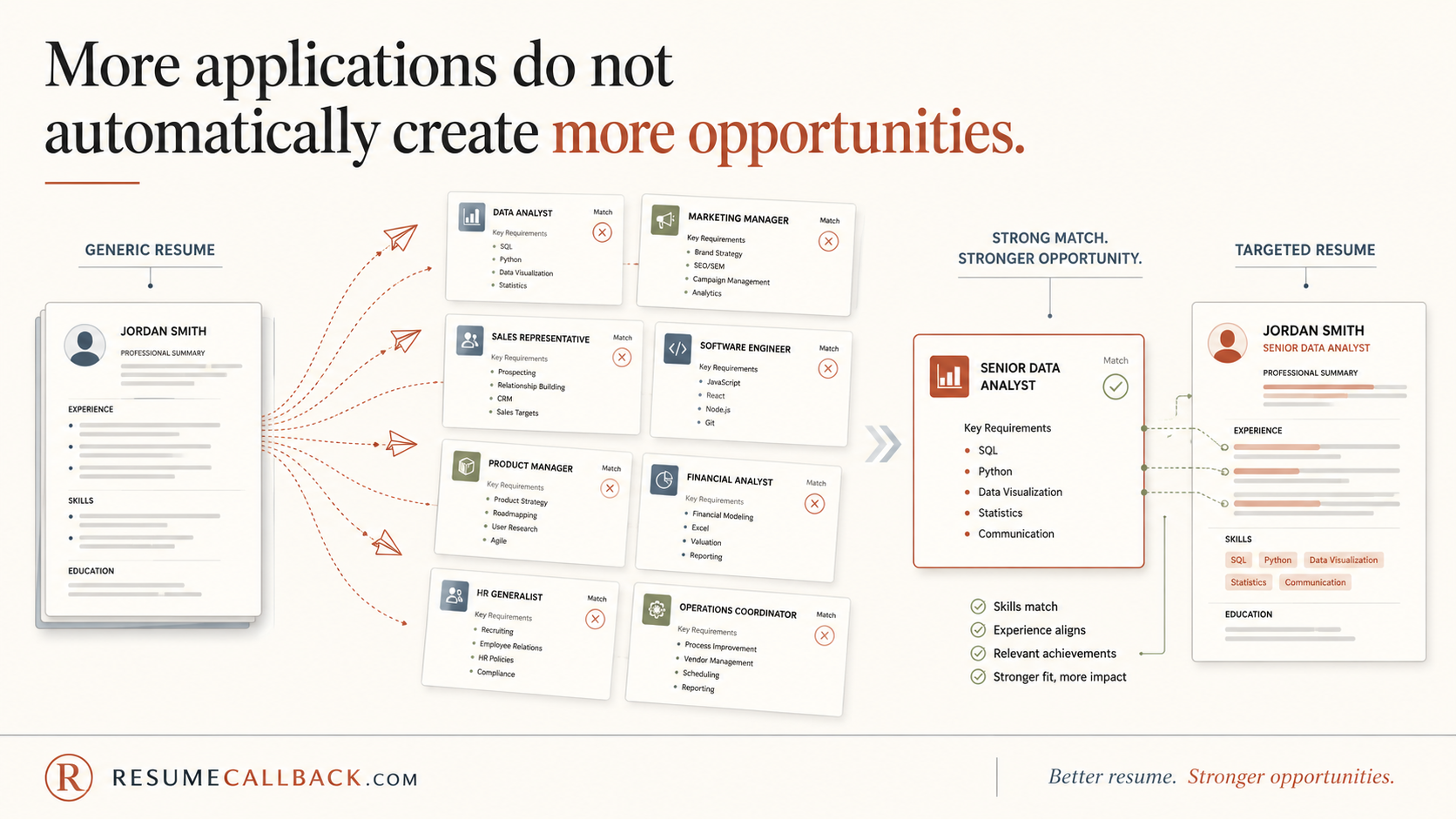
You send 200 applications believing that more visibility must increase your chance of getting a callback.
The arithmetic feels simple: more applications should create more opportunities.
That logic only works when each application is a credible opportunity and the resume clearly presents the evidence that position requires. Most spray-and-pray applicants are not submitting 200 carefully constructed applications. They are distributing one generalized resume across dozens or hundreds of different requirements.
Sometimes the jobs are unrelated. More often, they are related but not interchangeable. They may sit in the same profession while emphasizing different specialties, levels of responsibility, industries, technologies, certifications, or business problems.
The candidate may be qualified for many of them. The resume may still fail to prove it.
Spray and pray does not create 200 strong opportunities. It creates 200 chances for one generalized document to match 200 different hiring requirements.
That is not a strategy. It is a game of luck.
Application volume changed the hiring process
Applying has become easier. Candidates can find a job, generate a cover letter, alter a few resume phrases, and submit within minutes. Automated tools can accelerate the process further.
Employers do not necessarily add recruiters at the same rate that applications increase. Many respond with applicant-tracking systems, database search, filters, candidate matching, summaries, prioritization, and workflow automation.
Candidates use technology to submit more applications. Employers use technology to reduce the number of applications people must review.
The generic resume is caught between those two trends.
Your resume may become searchable evidence before it is read
Many candidates imagine a recruiter opening every resume and reading it from beginning to end. That still happens, but it should not be treated as the guaranteed first step.
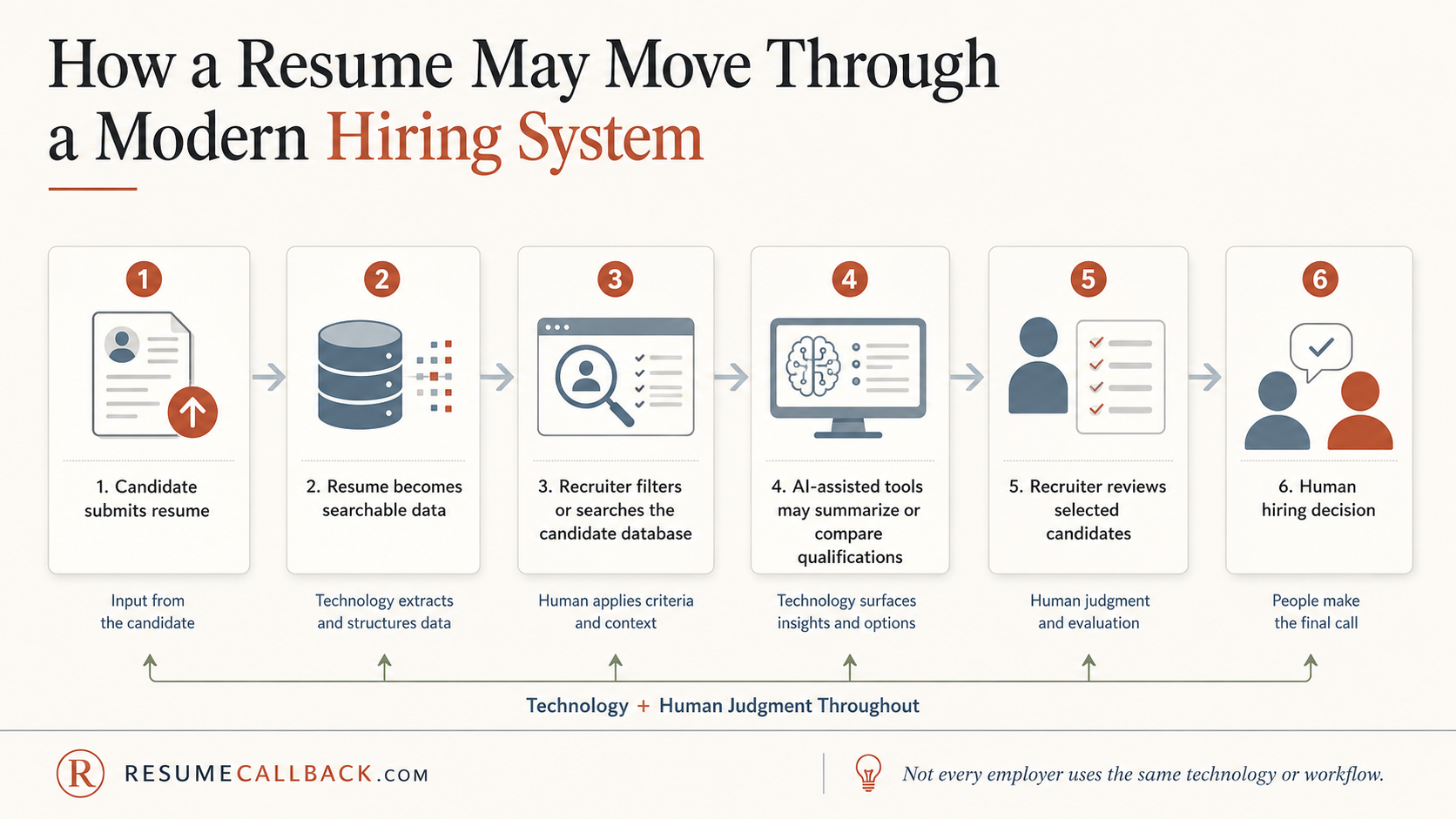
A resume may become a record inside an applicant-tracking system or recruiting platform. Recruiters can search, filter, compare, summarize, and prioritize candidates before opening individual documents for a detailed review.
LinkedIn documents an Advanced AI-Assisted Search capability that lets eligible Recruiter users paste job descriptions or describe the candidate they need. Greenhouse describes AI-powered candidate matching calibrated to employer criteria. Workday markets AI-assisted recruiting and candidate recommendations.
Not every employer uses the same tools. These systems do not prove that a robot makes every hiring decision. They do show that resumes increasingly need to function as searchable and comparable evidence of fit.
One resume cannot emphasize everything equally
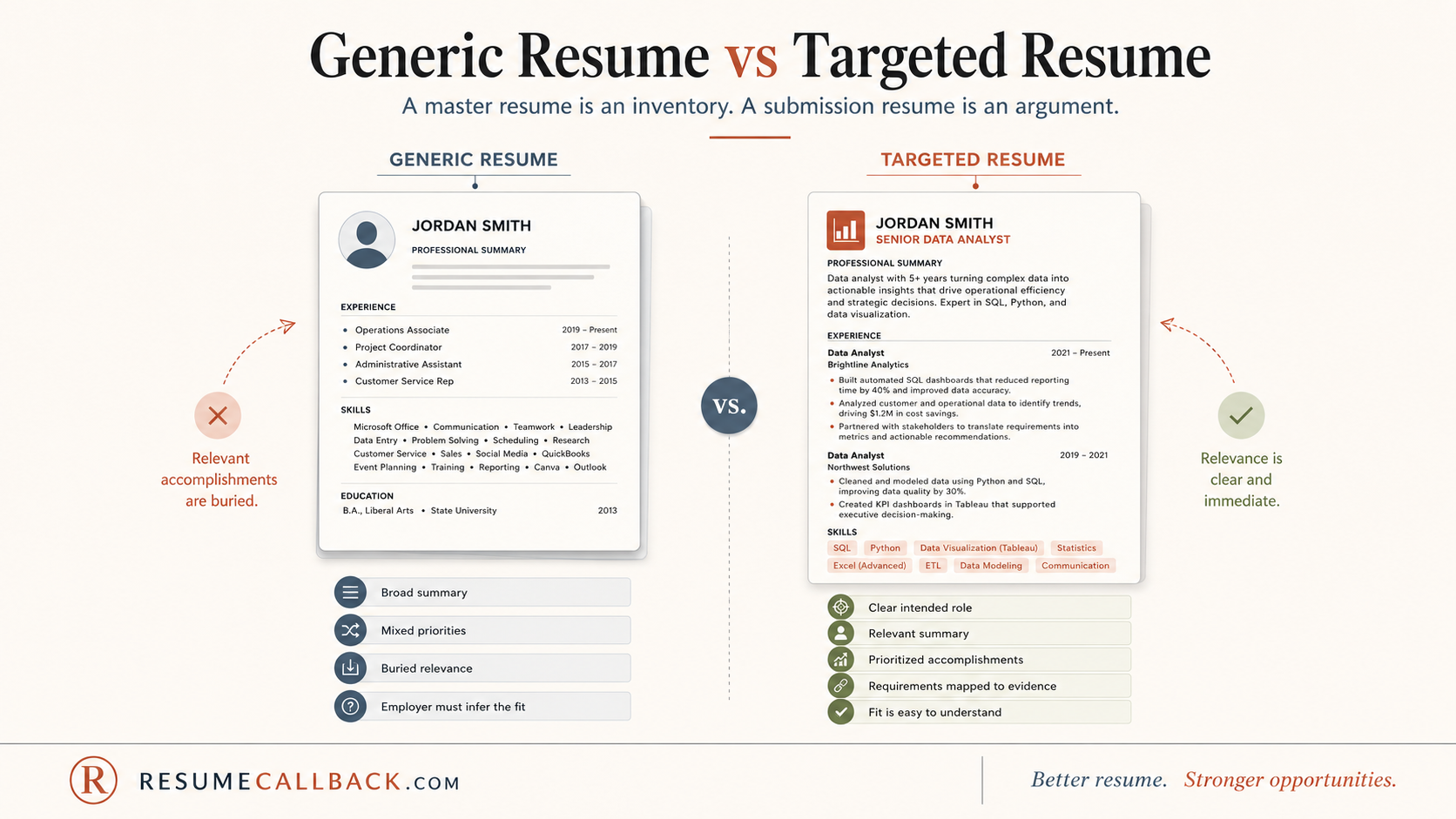
Consider a technology leader qualified for both infrastructure and cybersecurity leadership.
An infrastructure role may emphasize enterprise operations, availability, cloud transformation, budget ownership, vendor management, service delivery, and team leadership.
A cybersecurity role may emphasize risk reduction, security architecture, governance, compliance, identity, incident response, and security-team leadership.
The experience can be truthful and relevant to both. A two- or three-page document cannot give every capability equal prominence.
A targeted resume does not invent different experience for each job. It organizes truthful experience according to the employer's stated need.
The mechanics of that reorganization are worth their own treatment — we cover them in Why One Generic Resume Cannot Match Every Related Role.
A master resume is an inventory
A master resume should contain the complete record: roles, accomplishments, certifications, technologies, projects, scale, and measurable results.
That does not mean it should be submitted unchanged.
The master resume says: Here is everything I have done.
The submission resume says: Here is the evidence that I can solve the problems described in this position.
A generic resume forces the recruiter or system to determine what matters, infer transferable skills, translate terminology, ignore irrelevant material, and locate evidence that may be buried several bullets deep.
Do not make the hiring process solve the puzzle for you.
Activity is not progress
A full application tracker can feel productive. Confirmation emails create visible proof that work was completed.
Application count is still an activity metric.
A better search measures:
- Applications that meet the central requirements
- Applications submitted with a targeted resume
- Recruiter response rate
- Screening-call rate
- Interview rate
- Interview-to-offer conversion
- Response by role family
- Results by resume positioning
Illustrative example: 200 generic applications at a 1% response rate produce two responses. Thirty targeted applications at a 10% response rate produce three. Those percentages are examples, not industry benchmarks.
Application count measures activity. Conversion measures whether the strategy is working.
Before your next application: Analyze your resume against a job description to see the match score, missing evidence, and rejection risks.
Related jobs still require different positioning
A cybersecurity candidate can apply only to cybersecurity jobs and still apply too broadly.
Security operations, governance and risk, cloud security, identity, product security, operational technology security, and security architecture are connected disciplines. They do not purchase the same expertise.
Related does not mean interchangeable.
The question is not simply whether you have worked in the field. The question is whether you have solved the problems this employer needs solved — and whether your resume makes that evidence easy to find.
Tailoring is not keyword stuffing
Targeting does not mean copying every phrase from a job description.
It does not mean adding skills you do not possess, hiding keywords, repeating terms unnaturally, or turning limited exposure into claimed expertise.
Weak:
Cybersecurity strategy, cybersecurity governance, cybersecurity risk management.
Stronger:
Developed a three-year cybersecurity roadmap aligning governance, architecture, identity, vulnerability management, and incident response with enterprise risk priorities.
The first statement lists claims. The second provides application and context. The distinction matters more as recruiting platforms move from exact-match filters toward interpretation of meaning — a shift we unpack in How AI and Semantic Search Are Changing Resume Review.
A practical targeting process
- Identify why the employer is hiring the role.
- Separate mandatory requirements from preferences.
- Map major requirements to specific evidence.
- Prioritize the most relevant accomplishments.
- Use the employer's terminology where it accurately describes your work.
- Remove information that supports a competing career narrative.
- Review the final document as a hiring argument.
Ask whether the intended role is obvious, the strongest qualifications are visible, each claim has evidence, and the reader can understand the fit without making assumptions.
Fewer applications does not mean waiting for perfection
A targeted strategy can still support several active applications.
Maintain a master resume and several role foundations — for example infrastructure leadership, cybersecurity leadership, risk and compliance, program management, architecture, or professional services. Tailor the appropriate foundation for the serious opportunity in front of you.
The objective is not perfection. It is controlled relevance.
Stop applying blind
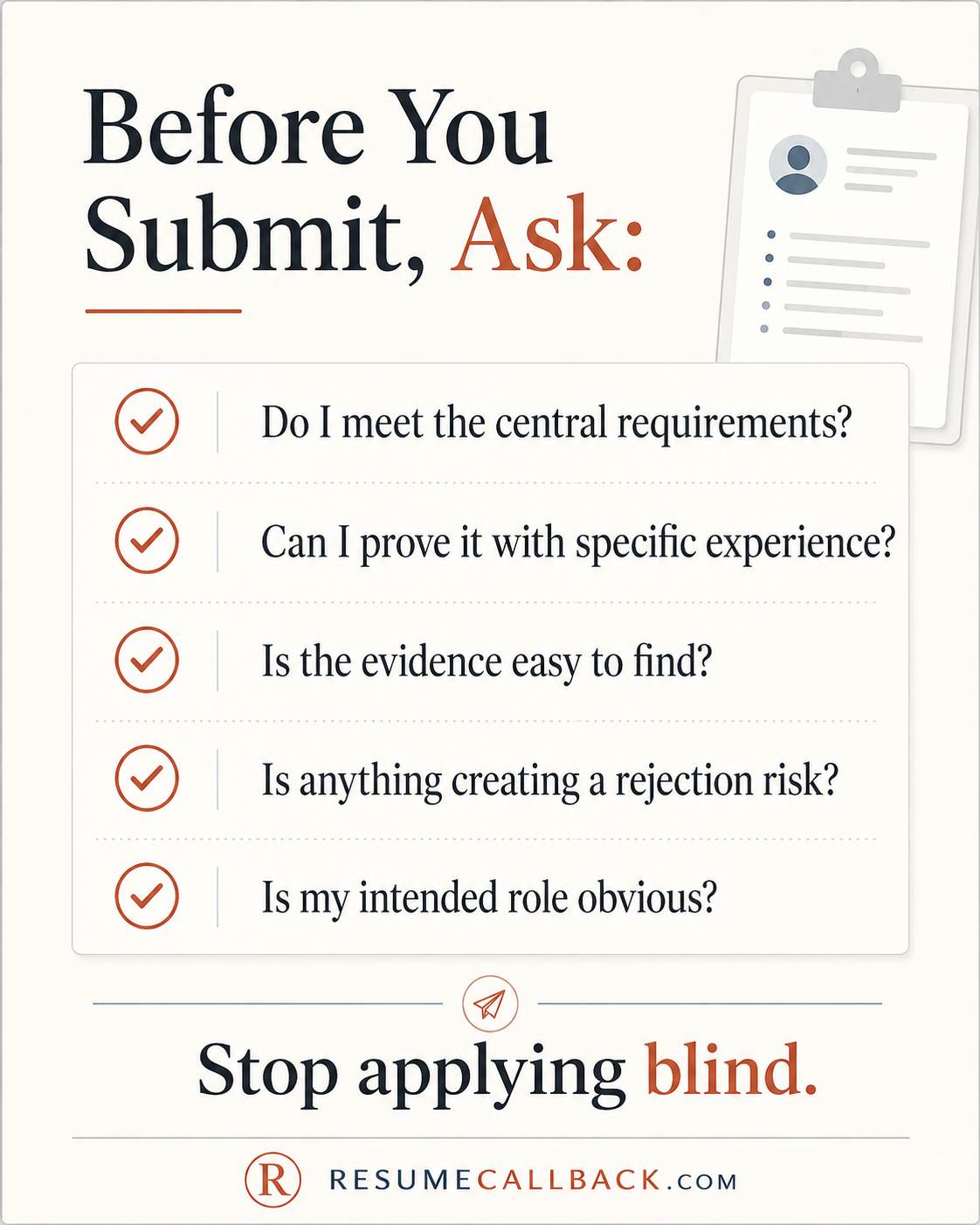
Before submitting, ask:
- Do I meet the central requirements?
- Can I prove that with specific experience and outcomes?
- Does my resume prioritize that proof?
- Have I removed information that weakens or confuses the match?
- Would a recruiter understand my fit without making assumptions?
Your objective is not to submit the greatest number of applications. It is to create the greatest number of credible opportunities.
Stop spraying your resume across the internet and hoping someone — or some system — figures out where you belong.
Apply with evidence. Apply with alignment. Apply with intent.
Before You Submit Your Next Application
ResumeCallback evaluates the resume and job description together, identifies missing evidence and potential rejection risks, and helps you decide what to emphasize before applying. Do not wait for another rejection to learn that your resume failed to communicate the match.