Easy Apply Makes Applying Easier. It Does Not Make You Easier to Hire.
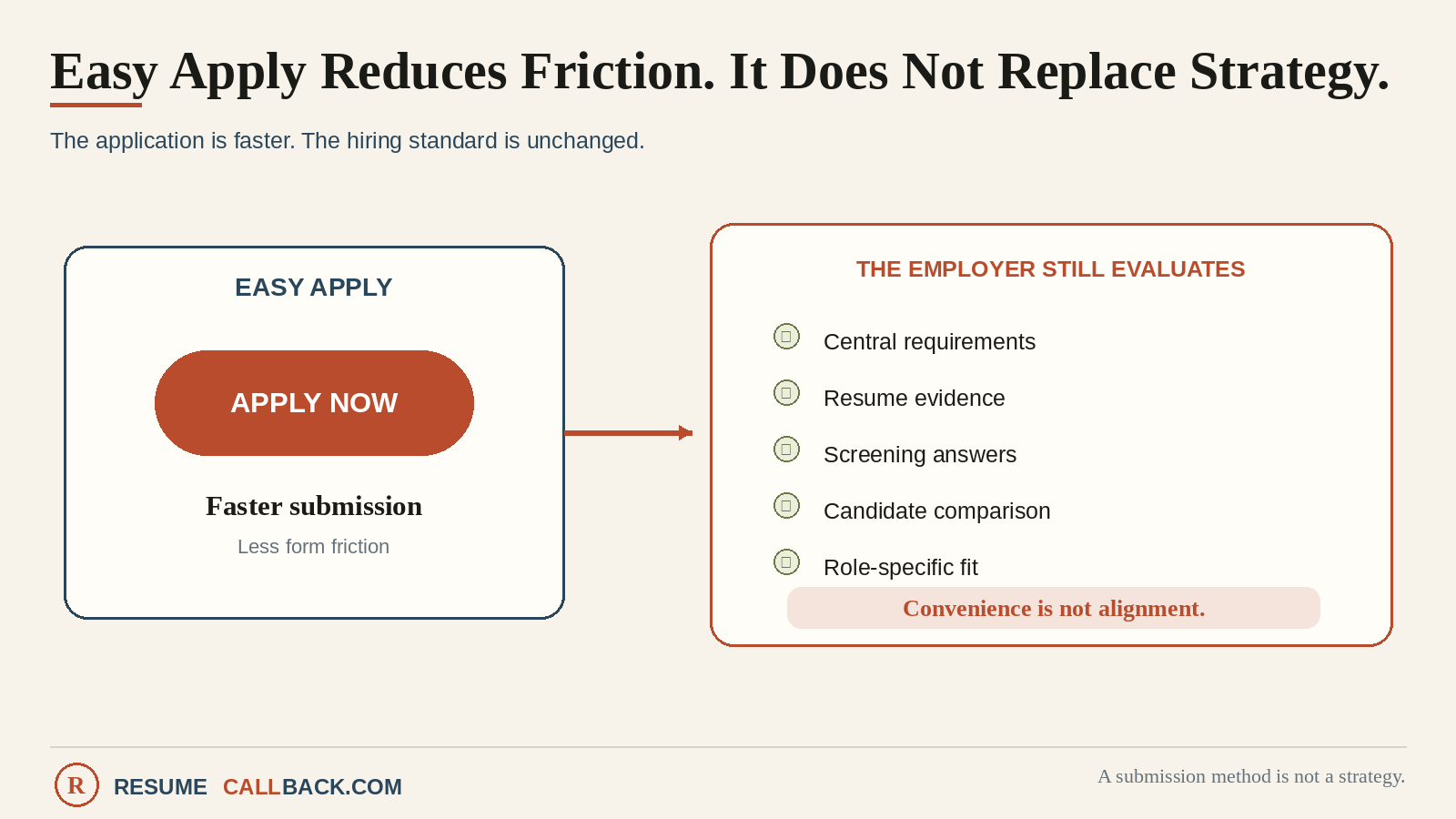
Easy Apply reduces submission friction, but it does not replace resume tailoring, profile alignment, job verification, or application strategy.
Easy Apply feels like relief.
When you are exhausted from searching, rewriting, creating accounts, answering the same questions, and receiving little response, a one-click application feels like the only part of the process designed for you.
The convenience is real.
The strategic value is not automatic.
LinkedIn describes Easy Apply as a streamlined application experience that lets candidates submit without leaving LinkedIn. LinkedIn also states that the application is sent to the job poster, relevant profile skills may be included, and uploaded resumes can be saved and reused for future applications.
That explains what the feature does.
It does not establish that one broad profile and one reusable resume are the strongest application for every role.
Easy Apply is a submission method. It is not a complete job-search strategy.
This piece sits inside the Applicant Intelligence framework — a small library on how modern hiring actually works and how candidates can respond to it deliberately.
The button reduces effort — not competition
Easy Apply reduces the effort required to submit an application.
It does not reduce:
- The number of other applicants
- The employer's required qualifications
- Knockout questions
- Recruiter search criteria
- Resume comparison
- Hiring-manager expectations
- The need to demonstrate relevant experience
The application may be easier to send. The candidate is not easier to select.
The button reduces submission friction. It does not reduce the evidence required to compete.
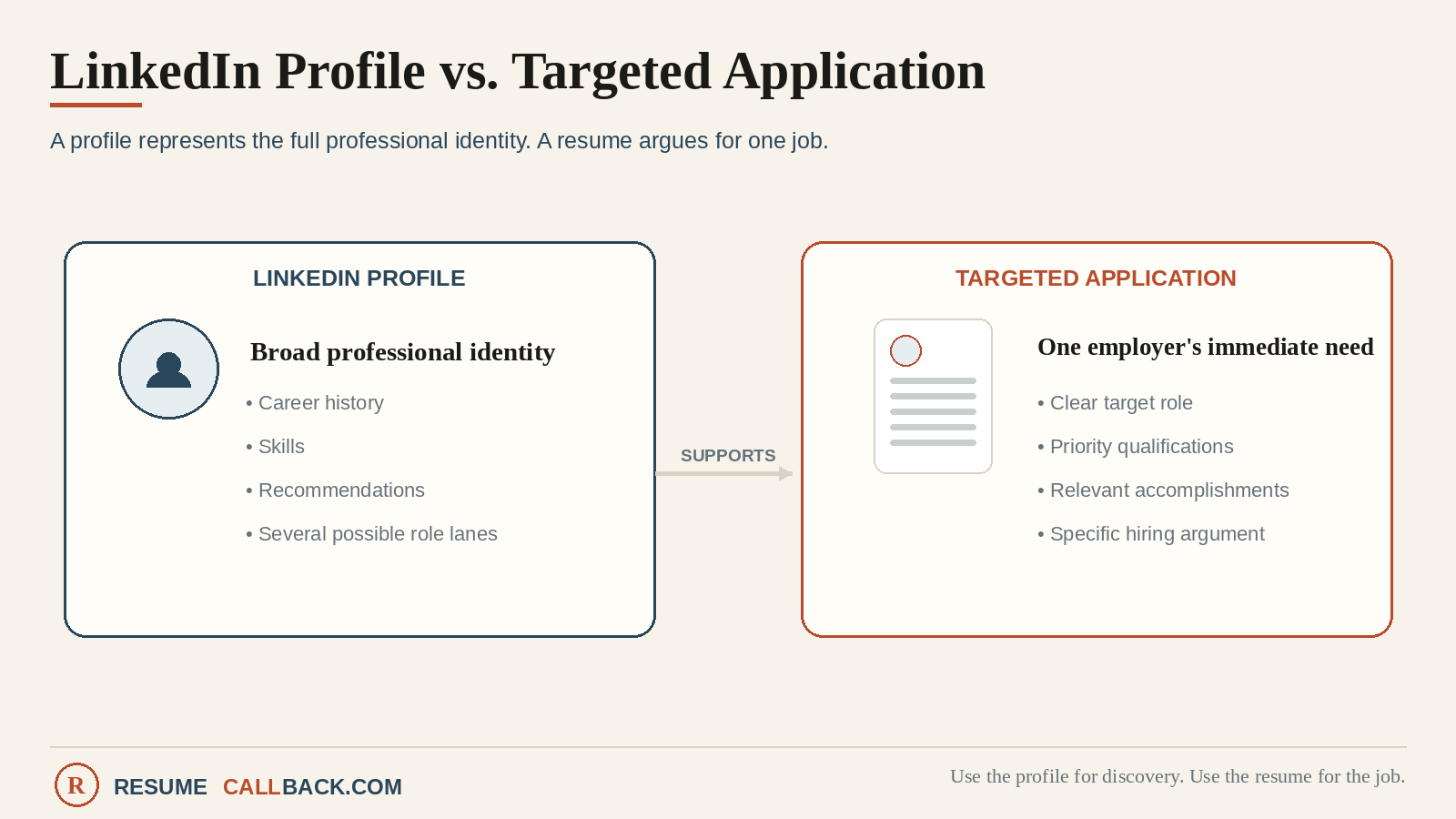
A LinkedIn profile is broad by design
A LinkedIn profile is useful because it creates a persistent professional identity.
It can show:
- Career history
- Skills
- Recommendations
- Certifications
- Education
- Publications
- Projects
- Professional activity
That breadth supports networking and discovery.
A specific job is not broad.
One role may prioritize customer retention. Another may prioritize project delivery. Another may prioritize technical troubleshooting, regulatory compliance, team leadership, or operational recovery.
The same person can qualify for several roles.
A single profile cannot emphasize every role-specific argument equally.
That is why the profile should support the resume, not replace it.
Saved resumes create convenience and risk
LinkedIn can retain recently uploaded resumes for reuse.
That is operationally useful.
It can also encourage a candidate to choose the nearest available resume instead of the strongest one for the job.
The applicant should know:
- Which resume version was used
- Which role family it supports
- Whether the headline and summary align
- Whether the most important qualifications are visible
- Whether the LinkedIn profile tells a conflicting story
Resume reuse is not the problem.
Uncontrolled resume reuse is.
When Easy Apply is appropriate
Easy Apply can be a reasonable application path when:
- The role is clearly within your target lane
- The posting appears legitimate and current
- Your resume is already aligned or has been tailored
- Your LinkedIn profile supports the same professional direction
- You meet the central requirements
- Your answers to screening questions are accurate
- The employer uses LinkedIn as the intended route
- You can track the submission and resume version
The problem is not the platform.
The problem is using the speed of the platform to avoid the judgment the application requires.
Before your next application: Analyze your resume against a job description to see the match score, missing evidence, and rejection risks.
When Easy Apply becomes dangerous
Easy Apply becomes risky when:
- You are using one resume across unrelated job families
- You have not read the entire posting
- You do not meet a central requirement
- The title does not align with your resume narrative
- The most important experience is buried
- The job appears stale, duplicated, vague, or suspicious
- You are increasing volume because response is low
- You cannot explain why this opportunity is a credible fit
A fast weak application is not an advantage.
It is only a weak application submitted faster.
Volume, without verification, can also mean tailoring an application for a posting that was never active in the first place. That is a separate problem covered in the companion piece on how to tell a ghost job, stale posting, or scam apart before applying.
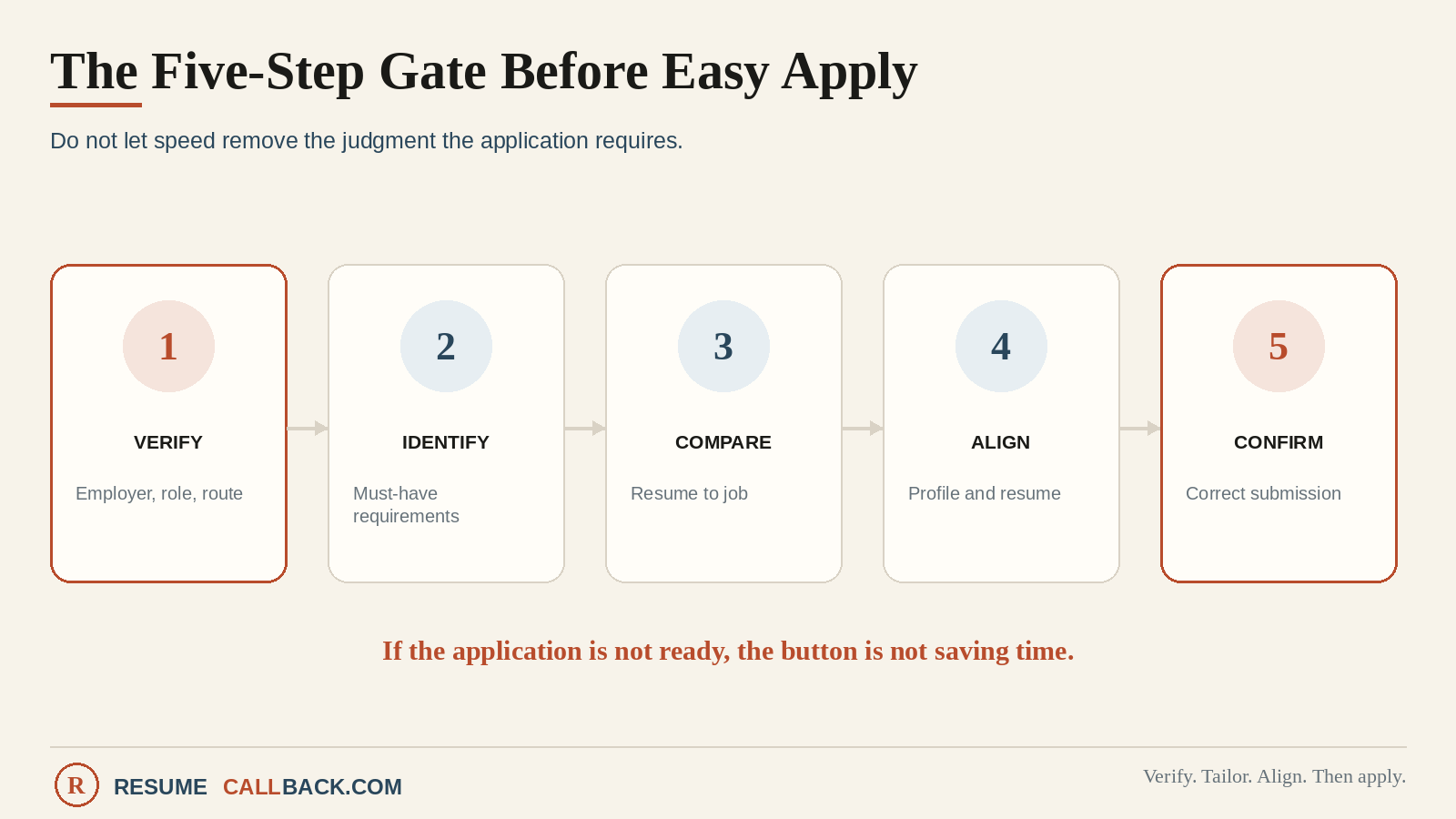
The five-step Easy Apply gate
Before clicking Easy Apply:
1. Verify the opportunity
Confirm the employer, location, posting, and application route.
2. Identify the must-have requirements
Separate central requirements from preferences. If you are unsure which qualifications the employer is actually using to screen, the companion piece on how to dissect a job description walks through the read.
3. Compare the resume and the job
Locate the evidence for each major requirement.
4. Align the profile
The profile does not need to repeat the resume, but it should not contradict the role, level, or career direction.
5. Confirm the submission
Know which resume version was used and record the application.
If you cannot complete those steps, the convenience of the button is not solving the real problem.
The profile is not good enough by itself
A complete profile can still produce a weak application.
The profile may prove that you are experienced.
The resume must prove why that experience matters for this job.
That distinction is especially important for:
- Career changers
- Candidates with broad leadership backgrounds
- Professionals pursuing multiple related role families
- Applicants whose official titles do not match market titles
- Candidates with older but relevant experience
- Technical leaders moving between infrastructure, security, cloud, and operations
A broad profile asks the employer to interpret the candidate.
A targeted resume performs the interpretation first.
Use the strongest legitimate path
Some jobs should be submitted through Easy Apply.
Some should route to the employer's site.
Some organizations intentionally use a connected application process.
The applicant's rule should not be "never use Easy Apply."
It should be:
Verify the job. Tailor the resume. Align the profile. Use the employer's legitimate intended route.
Before you submit
Ask:
- Is this opportunity real and active?
- Do I meet the central requirements?
- Does this resume prove the match?
- Does my LinkedIn profile support the same story?
- Am I using Easy Apply because the application is ready — or because I am tired?
A fast application is not the goal.
A strong application is.
Analyze Before You Apply
ResumeCallback evaluates the resume and job description together so candidates can identify weakly supported requirements, surface rejection risks, and decide whether to tailor, apply, or skip.
Do not use convenience as a substitute for alignment.