Ghost Job, Stale Posting, or Scam? Verify the Opportunity Before You Apply.
Learn how to distinguish warning signs, verify an employer and posting, avoid job scams, and choose the legitimate application route.
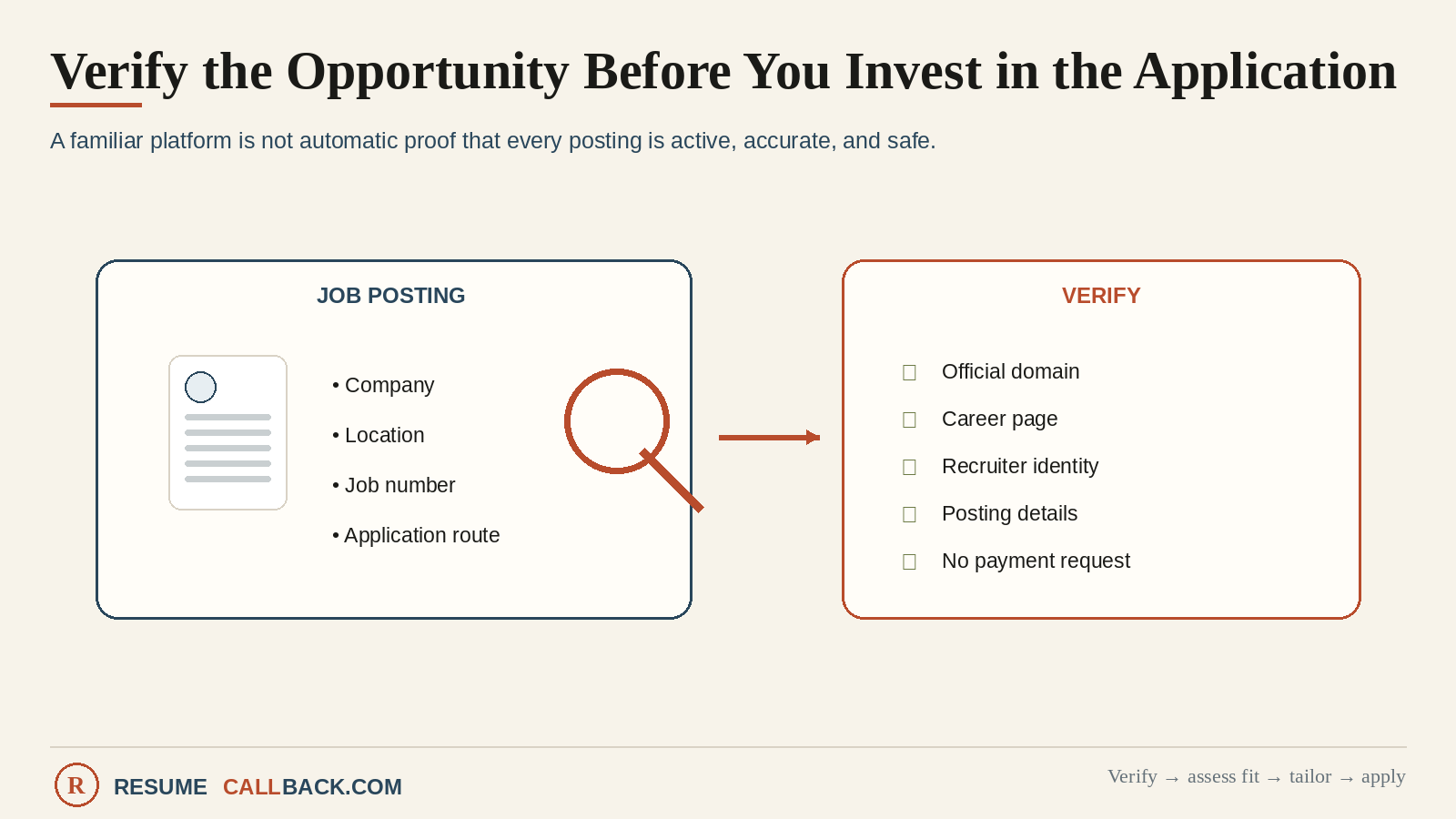
Before tailoring a resume for an hour, spend five minutes proving the opportunity exists.
That does not mean every slow employer is dishonest.
It means candidates should stop treating a listing on a familiar platform as automatic proof that the job is active, accurate, and safe.
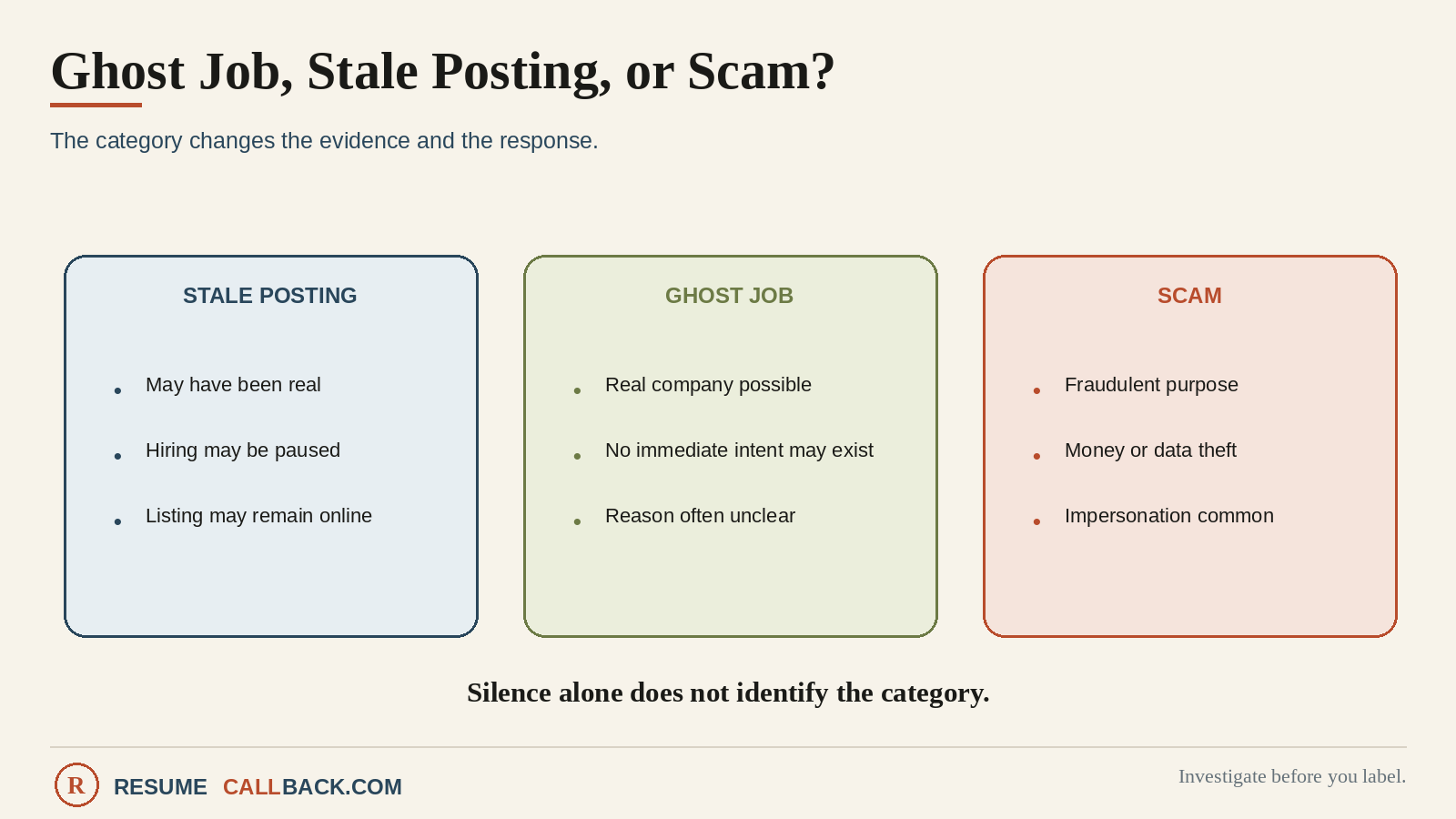
A posting can be:
- Legitimate and actively hiring
- Legitimate but stale
- A real employer gathering future candidates
- A role paused by budget or organizational change
- A duplicated or automatically reposted listing
- A ghost job with no immediate hiring intent
- A scam impersonating a real employer
Those are different problems and require different responses. Verification is the first move in the Applicant Intelligence framework — a small library on how modern hiring actually works and how candidates can respond to it deliberately.
A scam job is fraudulent
A scam posting is designed to obtain money, personal information, account access, identity documents, or unpaid labor.
The Federal Trade Commission warns that scammers may impersonate known employers, use real company names, contact candidates through job platforms, offer remote work with vague responsibilities, send fake checks, or ask applicants to purchase equipment or transfer money. The FTC has issued specific alerts about scammers impersonating well-known companies to recruit for fake jobs on LinkedIn and other platforms.
Common scam indicators include:
- Interview conducted only through text or encrypted messaging
- Recruiter email from an unrelated domain
- Pay that is unusually high for vague work
- Immediate offer without meaningful evaluation
- Request for bank information before a legitimate onboarding stage
- Request to buy equipment, gift cards, or training
- Fake check sent for equipment purchases
- Pressure to act immediately
- Poorly matched company and job details
- Contact from a recruiter who cannot be verified
An honest employer does not need you to pay to receive a job.
A stale posting may have been legitimate
A stale posting may remain visible after:
- The role was filled
- The requisition was paused
- The budget changed
- The employer delayed hiring
- The posting expired incorrectly
- The platform duplicated or refreshed the listing
- The company continued collecting applicants without immediate review
Silence alone does not prove the posting was fake.
Indeed has publicly discussed ghost-job concerns while also noting that delayed hiring, changing plans, and application volume can explain why candidates hear nothing.
A ghost job is not always a scam
A ghost job may be associated with a real company and a plausible role but lack a current intent to hire.
Possible reasons include:
- Building a future pipeline
- Testing market compensation
- Demonstrating growth
- Replacing an employee confidentially
- Meeting internal posting requirements
- Keeping a frequently hired role open
- Hiring plans that changed after publication
The candidate cannot always prove the employer's intent.
The practical goal is not certainty.
It is risk reduction.
The company website is a verification point — not an absolute rule
Search the employer's official careers site.
Confirm:
- The same title
- Location
- Job number
- Department
- Posting date
- Reporting structure
- Application route
- Required qualifications
If the role does not appear, treat that as a warning.
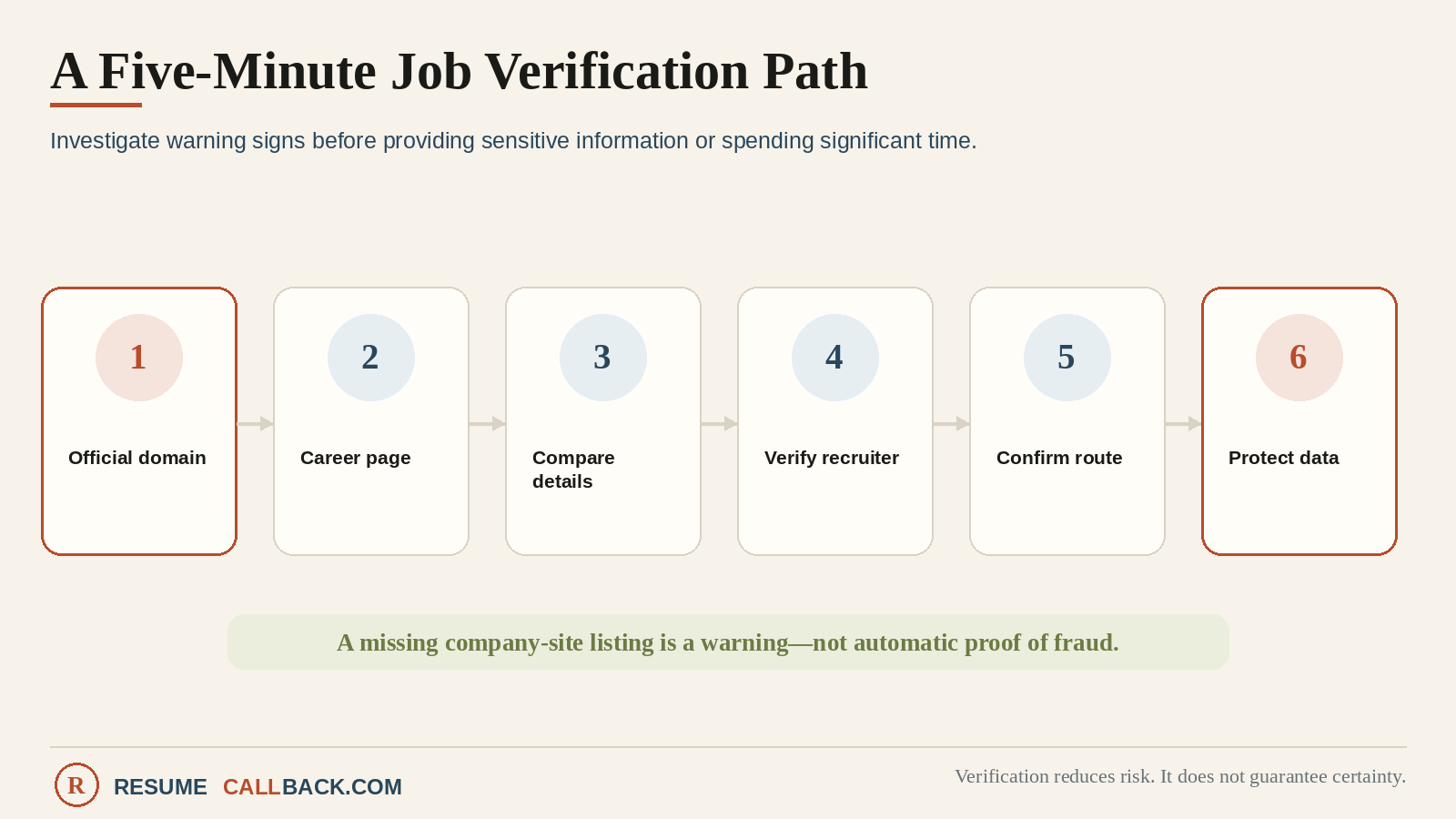
It is not conclusive proof of fraud. Some employers use external recruiting agencies, confidential searches, or platform-only postings.
The next step is verification — not accusation.
The five-minute verification process
1. Confirm the real employer domain
Navigate independently to the company site. Do not rely only on a link in a message.
2. Search the official career page
Use the job title, location, and job number.
3. Compare the descriptions
Look for material differences in responsibilities, compensation, location, and qualifications.
4. Verify the recruiter
Check whether the person exists, works for the company or agency, and uses a legitimate email domain.
5. Check the application route
Use the employer's official route whenever practical. If the employer intentionally uses LinkedIn, Indeed, or another connected system, confirm that path from the official employer presence.
6. Review the posting age and history
Repeated reposting is a signal to investigate, not automatic proof of deception.
7. Protect personal information
Do not provide bank details, Social Security numbers, copies of identity documents, or payment until the employer and onboarding process are legitimate.
Automate the verification: Company Research
Doing the seven steps by hand takes about five minutes per posting. Multiply that across an active job search and it becomes friction you will start skipping — which is when unverified applications creep in.
We built Company Research to remove that friction. It runs a live web search on the employer and returns a structured brief:
- A company snapshot — what the company actually does, who they compete with, recent size and funding
- Recent signals — news, layoffs, executive changes, expansions, product launches, anything in the last few months
- Culture themes — what employees and press consistently report about how the company operates
- Interview notes — process, common questions, timeline
- Talking points — specific things to bring up that show you actually know this company
- Risk flags — the reason this section exists in this article — anything a candidate should think twice about before applying
Every finding is cited to a public source, so you can click through and verify it yourself. No black box.

Instead of clicking through eight browser tabs to reconstruct steps 1–7, you save the job in your pipeline, run Company Research, and get the verification signals in about thirty seconds. If the risk flags surface something concerning, that is the fastest possible signal to walk away before you spend an hour on the resume.
Company Research is available on every paid plan and runs at four credits per report. Once generated, the brief also feeds into interview prep — so the questions you rehearse are calibrated to what is actually happening at that company right now.
Before your next application: Analyze your resume against a job description to see the match score, missing evidence, and rejection risks — but only after you have verified the posting is worth the effort.
Job boards are discovery systems
Job boards are valuable.
They help candidates discover companies, roles, locations, and market demand.
Discovery and verification are different functions.
A responsible workflow is:
- Find the job.
- Verify the company and role.
- Save the full description.
- Analyze the requirements.
- Tailor the resume.
- Apply through the legitimate intended route.
- Record the source and final application destination.
Do not waste tailoring effort on an unverified opportunity
Candidates are often told to tailor every resume.
That advice assumes the opportunity deserves the effort.
Verification should come first.
The best order is:
Verify → assess fit → tailor → apply
Not:
Tailor → submit → discover the listing was questionable
Reader tip: if you are pushed toward one-click convenience once you decide to apply, the companion piece on why Easy Apply is a submission method rather than a strategy is a useful next read. If you want to understand what the posting is actually telling you before applying, see how to dissect a job description.
Red flags are cumulative
One unusual detail may have an innocent explanation.
Several aligned warning signs create a stronger reason to stop.
For example:
- Remote role
- High pay
- Vague duties
- Text-only interview
- Personal email domain
- Immediate offer
- Equipment check
That combination is materially different from one typo in a legitimate posting.
When to walk away
Stop the process when:
- The employer cannot be verified
- The recruiter identity is inconsistent
- Money is requested
- The offer arrives before real evaluation
- The job details change materially
- The application route collects unnecessary sensitive information
- The company denies the posting exists
- The communication becomes threatening or urgent
A job search already requires enough risk.
Do not accept avoidable risk because the market is difficult.
Verify Before You Tailor
ResumeCallback can help evaluate fit and tailor the application after the opportunity is verified. The first scoring decision is not whether your resume matches the job. It is whether the job is real enough to deserve your resume.