How to Dissect a Job Description and Discover What the Employer Actually Needs
Use repeated themes, verbs, qualification order, and business language to identify likely employer priorities and map them to resume evidence.
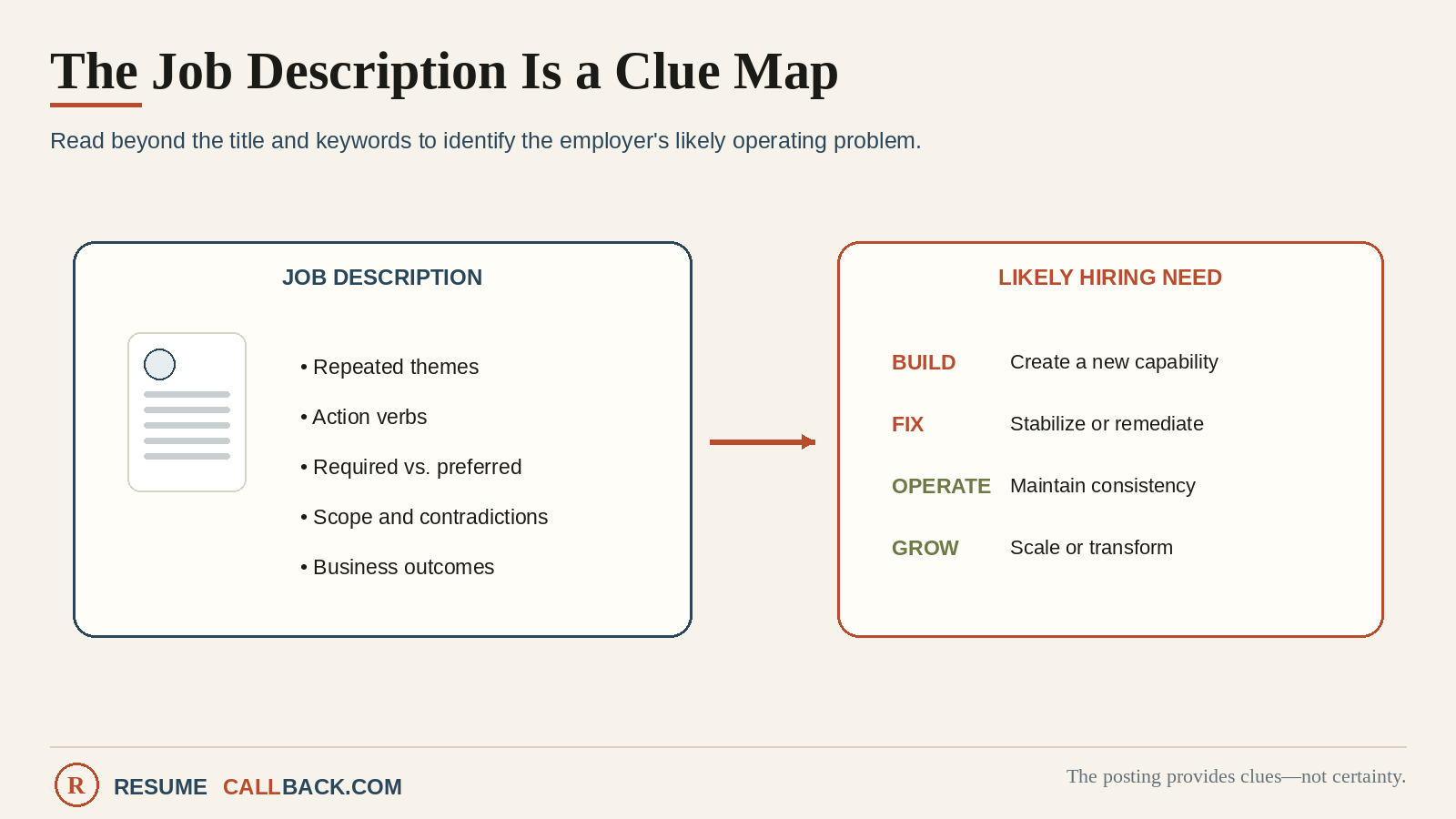
A job description is not a complete explanation of the employer.
It is still one of the most useful pieces of evidence a candidate receives.
Most applicants scan for title, salary, location, and familiar keywords.
A stronger applicant reads for:
- Business purpose
- Repeated priorities
- Required outcomes
- Organizational maturity
- Hiring-manager pressure
- Screening criteria
- Hidden tradeoffs
- Evidence the resume must provide
The posting cannot tell you exactly what the hiring manager thinks.
It can reveal what the organization decided to publish, emphasize, and require.
This piece belongs to the Applicant Intelligence framework — a small library on how modern hiring actually works and how candidates can respond to it deliberately.
Start with the role's business purpose
Ask:
Why is this company hiring this person now?
Common purposes include:
- Build a new function
- Stabilize a struggling environment
- Replace a departed leader
- Scale growth
- Modernize technology
- Reduce cost
- Improve compliance
- Recover a delayed program
- Integrate an acquisition
- Strengthen customer retention
- Increase operational discipline
The title tells you the category.
The business purpose tells you the argument your resume must make.
Read the verbs
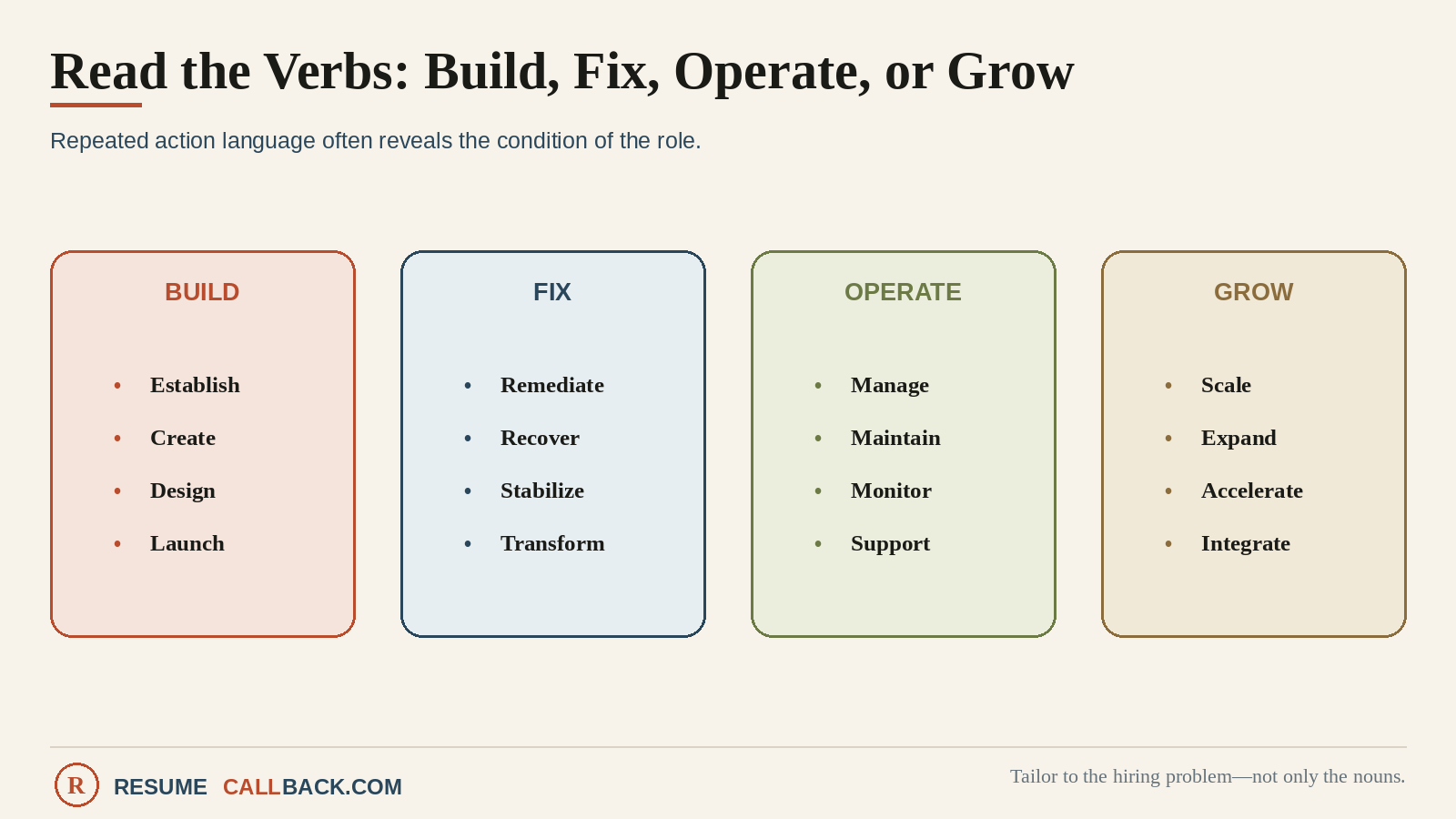
Verbs often expose the operating condition of the role.
Build verbs
- Establish
- Create
- Design
- Launch
- Develop
- Stand up
These suggest a new capability or immature function.
Repair verbs
- Remediate
- Recover
- Stabilize
- Correct
- Transform
- Improve
These suggest pain, failure, risk, or executive concern.
Operating verbs
- Manage
- Administer
- Maintain
- Monitor
- Support
- Coordinate
These suggest ongoing execution and process consistency.
Growth verbs
- Scale
- Expand
- Accelerate
- Increase
- Optimize
- Integrate
These suggest capacity, market, or organizational change.
A posting can contain several categories.
The repeated category is usually more important than one isolated word.
Track repeated themes
Create a simple count.
If the posting mentions stakeholder management seven times, leadership once, and technical design twice, the role may be more coordination-heavy than the title suggests.
Repeated themes may include:
- Customer interaction
- Executive communication
- Compliance
- Team development
- Delivery speed
- Architecture
- Revenue
- Risk
- Process
- Cross-functional influence
- Hands-on execution
Repetition is not proof of weighting.
It is evidence of emphasis.
Separate required from preferred
Required qualifications may become:
- Knockout questions
- Recruiter screening criteria
- Minimum qualification checks
- Interview topics
- Compliance constraints
Preferred qualifications may differentiate candidates without eliminating everyone who lacks them.
The difficulty is that employers do not always use those labels consistently. Indeed's employer guidance on writing job descriptions reflects how loosely those sections are often drafted in practice.
Look for words such as:
- Must
- Required
- Minimum
- Mandatory
- Preferred
- Desired
- Plus
- Ideally
- Nice to have
Then assess whether the requirement appears central to the work.
A "preferred" certification repeated throughout a regulated role may matter more than the label suggests.
A long list of required technologies may be a wish list rather than a realistic minimum.
The posting provides clues, not certainty.
Before your next application: Analyze your resume against a job description to see the match score, missing evidence, and rejection risks.
Study the order
The first responsibilities and qualifications often receive more internal attention during drafting and review.
Do not assume the order is mathematically weighted.
Do ask why some items appear first, receive more detail, or are repeated in the summary.
Read for organizational maturity
Certain language suggests maturity.
Immature or developing function
- Build the program
- Establish governance
- Define standards
- Create repeatable processes
- Develop the roadmap
- Introduce metrics
Established function
- Operate within existing standards
- Maintain service levels
- Execute the roadmap
- Optimize current processes
- Manage established controls
Function under pressure
- Immediate remediation
- Executive visibility
- Regulatory deadlines
- High-priority transformation
- Rapid stabilization
- Audit findings
The candidate should adjust the evidence accordingly.
A builder resume should show creation and transformation.
An operator resume should show consistency, scale, and control.
A recovery resume should show diagnosis, prioritization, and measurable correction.
Look for contradictions
Contradictions can reveal unclear expectations.
Examples:
- Strategic leader plus 80% hands-on administration
- Entry-level title plus ten years of experience
- One-person team plus enterprise-wide ownership
- Low compensation plus executive accountability
- Broad transformation mandate plus no decision authority
- Remote role plus extensive local presence
A contradiction is not automatic proof that the job is bad.
It is an interview question.
Infer the likely hiring-manager focus carefully
You can form hypotheses such as:
- The manager needs someone who can create order.
- The organization is concerned about risk.
- The team lacks a specific capability.
- The role requires influence without authority.
- The manager values delivery speed.
- The function is shifting from tactical to strategic.
Label these as hypotheses.
Then verify them during networking or interviews.
Convert the posting into an evidence map
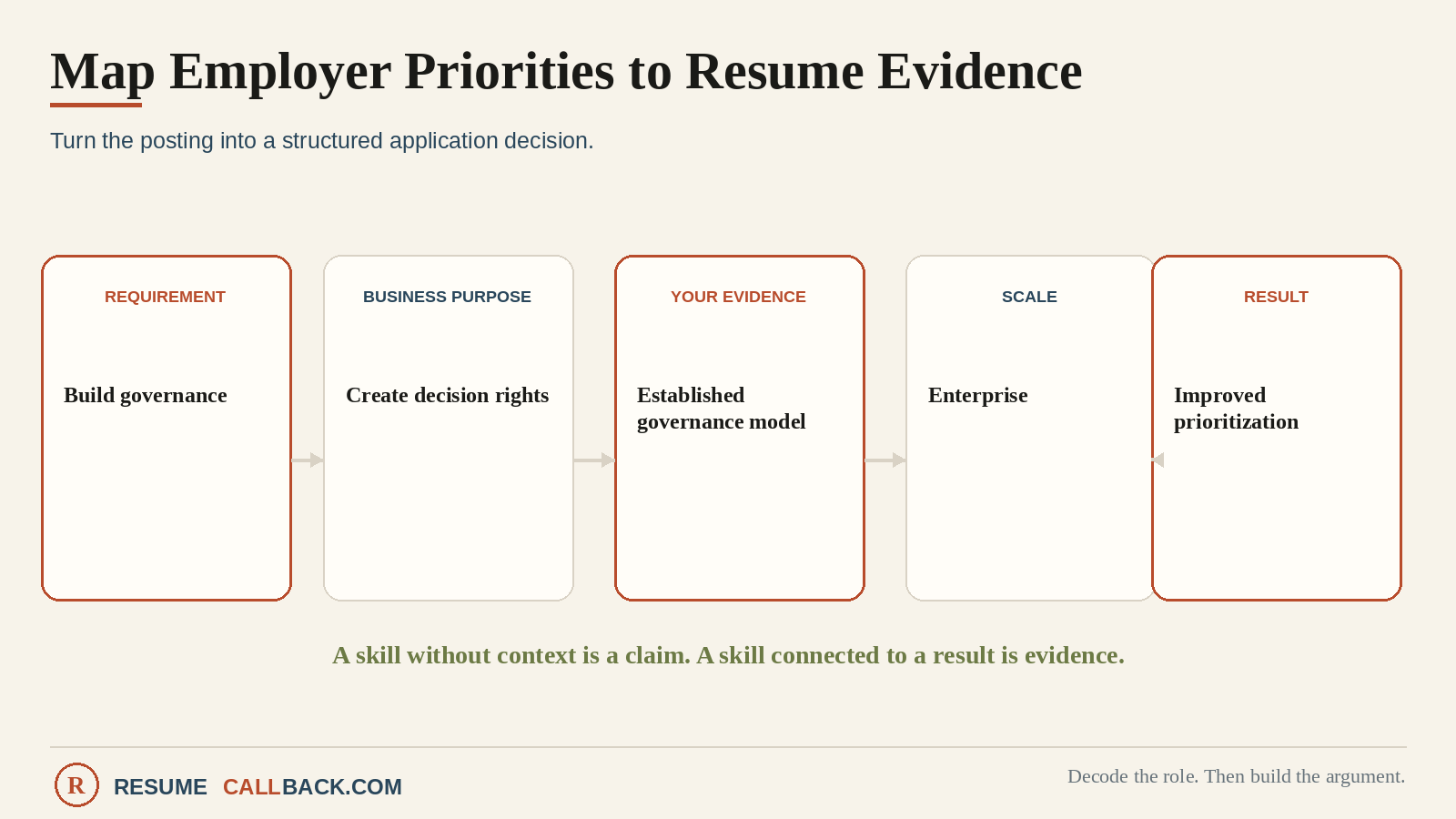
Create five columns:
- Requirement
- Likely business purpose
- Your matching experience
- Scale or complexity
- Result
Example:
Requirement: Build cybersecurity governance.
Likely purpose: The organization lacks consistent decision rights and standards.
Evidence: Established a governance model connecting architecture, risk, operations, and executive reporting.
Scale: Enterprise technology environment with distributed sites.
Result: Improved prioritization, accountability, and roadmap execution.
Separating the description of the work from the person-related requirements is where a lot of applicants get stuck. The companion piece on job analysis, KSAs, and candidate screening explains why postings often blur those two categories in ways that hurt qualified applicants.
Generate interview questions before applying
The strongest themes can become probable questions.
If the posting repeatedly mentions transformation:
- Tell me about a transformation you led.
- How did you sequence the work?
- What resistance did you face?
- How did you measure progress?
- What would you do in the first 90 days?
If the posting emphasizes stakeholder influence:
- Describe a decision you moved without direct authority.
- How did you handle competing executive priorities?
- How did you communicate technical risk to business leaders?
The job description is already giving you the interview study guide.
Use the description to decide whether to apply
A job description should change the application decision.
Apply when:
- You meet the central requirements
- You can prove the likely business outcomes
- The level and scope are credible
- The contradictions can be resolved
- The opportunity aligns with your target lane
Pause when:
- Mandatory constraints are missing
- The role combines incompatible jobs
- The employer need is unclear
- Your evidence supports a different position
- The application would depend on assumptions
Even a well-decoded posting is only worth your effort if the opportunity is real. Before you spend an hour tailoring, run through the checks in how to tell a ghost job, stale posting, or scam apart.
The posting is a clue map
Do not treat it as perfect.
Do not treat it as meaningless.
Use it to build the strongest available hypothesis about what the employer needs and what evidence the application must provide.
Decode Before You Tailor
ResumeCallback breaks down the job description, separates central requirements from preferences, identifies potential rejection risks, and helps candidates map resume evidence to the employer's apparent priorities. Do not tailor to keywords. Tailor to the hiring problem.