Why One Generic Resume Cannot Match Every Related Role
Related positions still prioritize different evidence. Learn how to maintain a master resume while tailoring truthful experience to each serious opportunity.
Candidates are often told to tailor their resumes, but the advice is frequently misunderstood.
Some interpret tailoring as rewriting every line for every job. Others interpret it as copying keywords from the posting. Many decide the effort is unrealistic and submit the same resume everywhere.
The better model is simpler:
A master resume is an inventory. A submission resume is an argument.
The master resume preserves everything. The submission resume selects and organizes truthful evidence for a specific hiring need. That distinction is the practical answer to the volume trap we describe in Spray and Pray Is Not a Job-Search Strategy.
Related roles are not interchangeable
A candidate may stay within one field and still pursue materially different roles.
Consider cybersecurity:
- Security operations
- Governance, risk, and compliance
- Cloud security
- Identity and access management
- Product security
- Operational technology security
- Security architecture
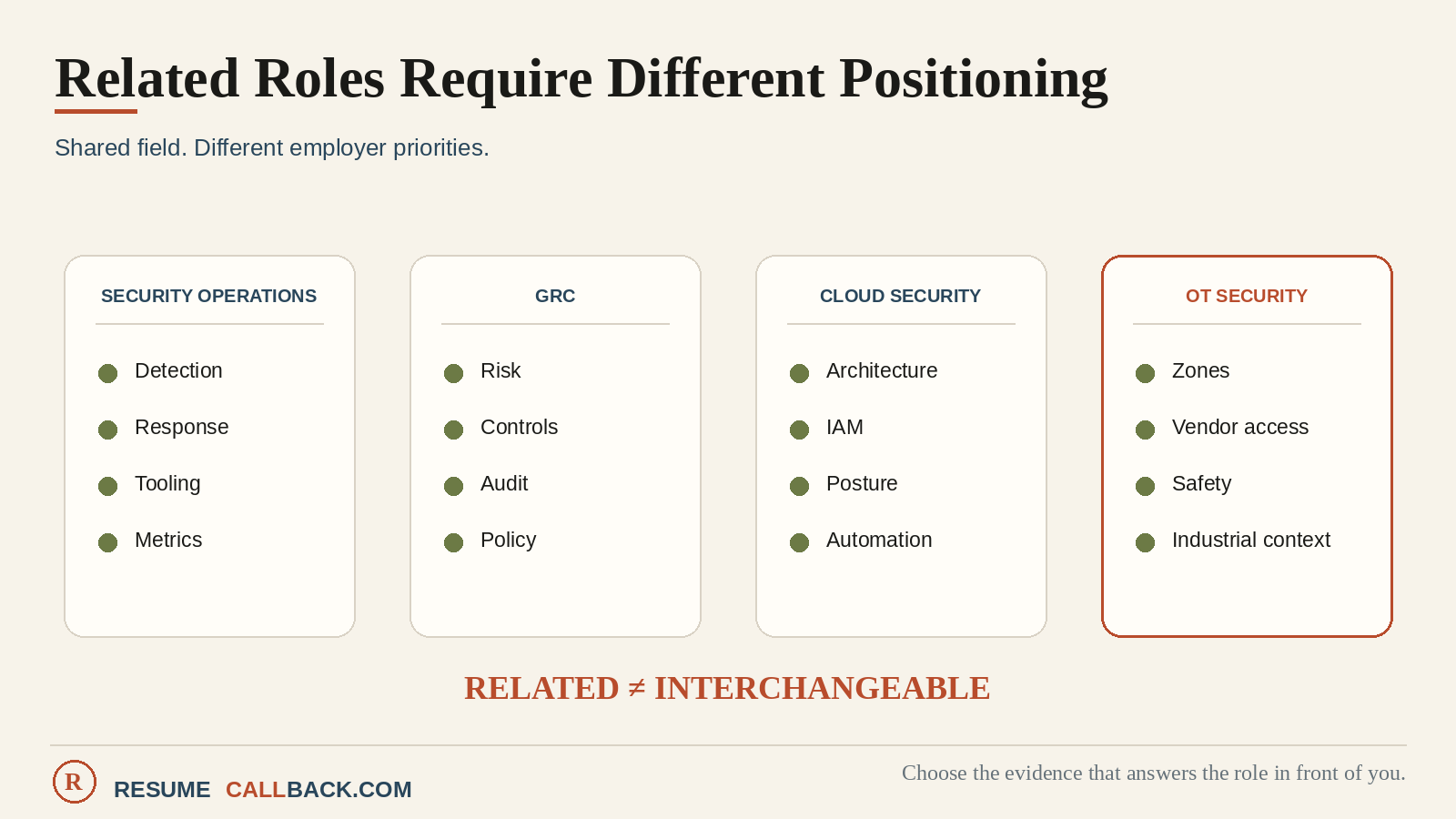
All are cybersecurity positions. They do not buy the same expertise.
A security operations role may emphasize detection, response, tooling, metrics, and team execution. A governance role may emphasize policy, risk, control frameworks, audit readiness, and executive reporting. An operational technology role may emphasize zones and conduits, industrial protocols, safety, vendor access, and constrained environments.
A single resume can mention all three. It may still fail to establish authority in any one of them.
Related does not mean interchangeable.
The master resume has a different job
The master resume should be comprehensive. It can include:
- Every role
- A larger accomplishment library
- Technologies
- Certifications
- Projects
- Metrics
- Industries
- Leadership scope
- Consulting engagements
- Older evidence that may matter for certain roles
This document may be longer than a submission resume. It is a source of truth, not a finished marketing document.
A role foundation is created from that inventory.
For example:
- Infrastructure leadership foundation
- Cybersecurity leadership foundation
- Risk and compliance foundation
- Professional services foundation
- Program leadership foundation
The final submission is then tailored from the relevant foundation.
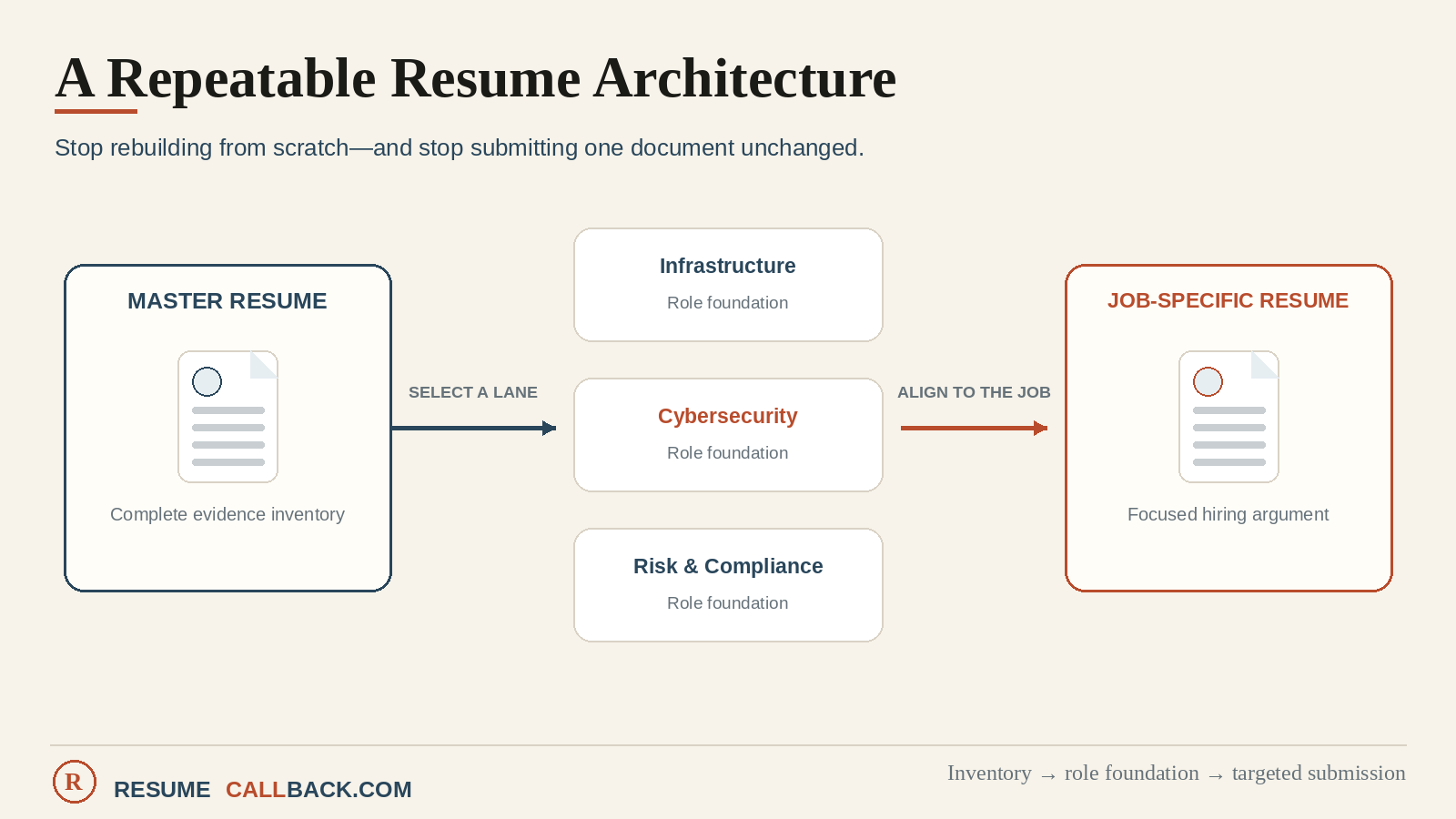
This approach avoids two bad extremes: rebuilding from scratch and sending one document unchanged.
Positioning changes emphasis, not facts
Truthful tailoring can change:
- Headline
- Summary
- Core competencies
- Order of accomplishments
- Space assigned to each role
- Technologies highlighted
- Certifications emphasized
- Older experience retained
- Language used to describe accurate experience
It does not change:
- Employers
- Dates
- Job titles without clarification
- Responsibilities
- Scope
- Outcomes
- Skills actually possessed
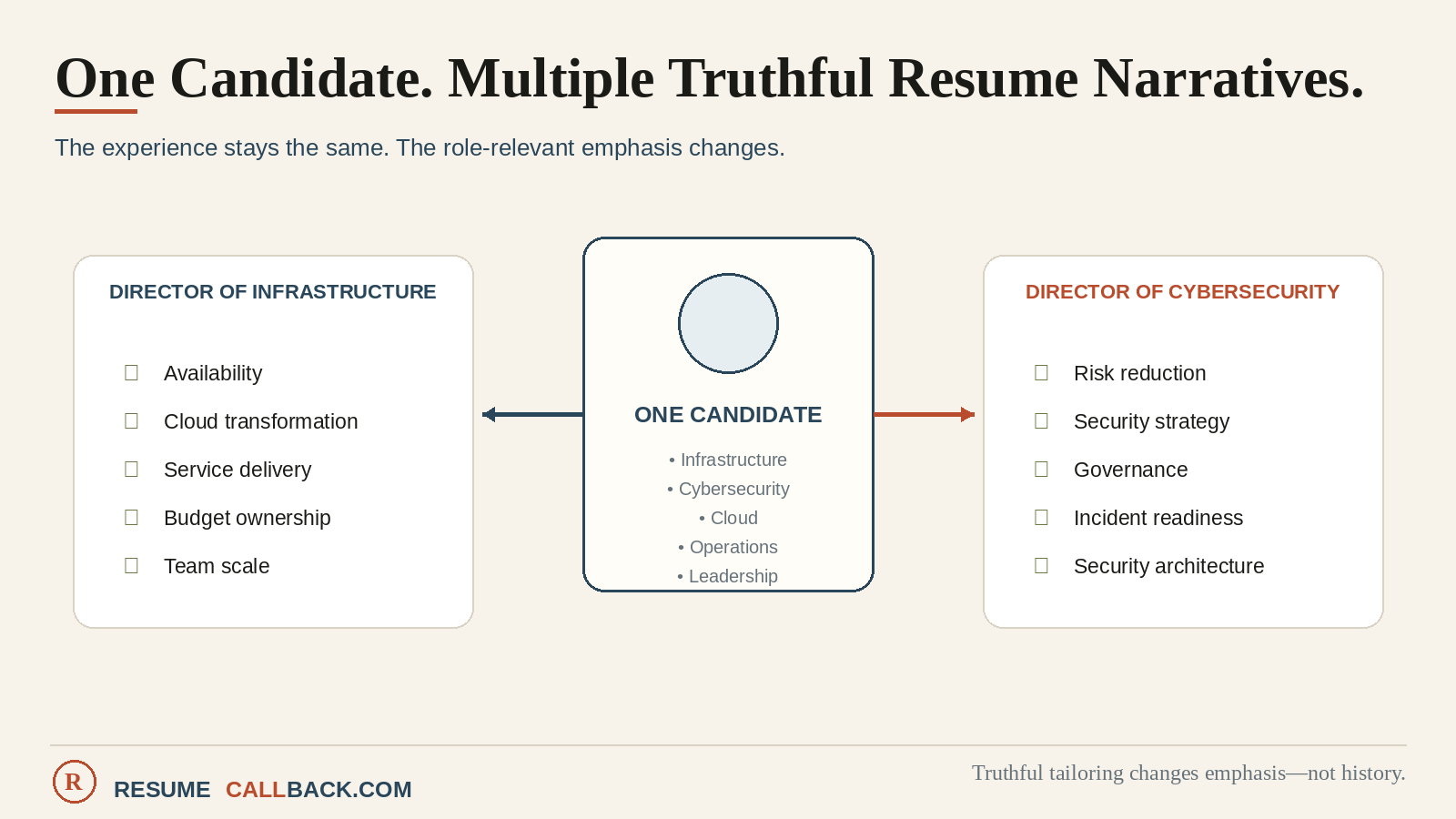
The experience remains the same. The evidence selected for the argument changes.
One candidate, two legitimate resumes
Imagine a leader with infrastructure, cloud, security, and operational technology experience.
For a Director of Infrastructure role, the resume might lead with:
- Enterprise availability
- Cloud and data-center transformation
- Service delivery
- Budget ownership
- Distributed operations
- Vendor management
- Team scale
For a Director of Cybersecurity role, the resume might lead with:
- Risk reduction
- Security architecture
- Identity
- Segmentation
- Incident readiness
- Governance
- Regulatory alignment
Both versions can be accurate.
The generic version often tries to combine every theme into one broad summary. The result may sound impressive but fail to answer the employer's immediate question: why this person for this role?
The cost of a competing narrative
Resume space is limited. Every section competes for attention.
An accomplishment can be valuable and still be wrong for the application.
A highly technical implementation bullet may weaken a strategic executive resume if it displaces leadership, risk, budget, or transformation evidence.
A broad management bullet may weaken a hands-on architecture application if it hides technical depth.
The question is not whether the content is impressive. The question is whether it strengthens the argument.
Before your next application: Analyze your resume against a job description to see the match score, missing evidence, and rejection risks.
A repeatable resume architecture
Layer 1: Master resume
A complete evidence inventory.
Layer 2: Role foundations
Several controlled narratives based on the roles you seriously pursue.
Layer 3: Job-specific submission
A focused version aligned to the actual posting.
This model makes tailoring faster. It also allows performance measurement. Candidates can track which foundation generates responses and where individual job alignment changes outcomes.
How to build a role foundation
- Define the target role family.
- Review 10–20 representative job descriptions.
- Identify recurring responsibilities and qualifications.
- Group your accomplishments around those themes.
- Select a headline and summary that establish the target.
- Build a core competency section based on truthful recurring requirements.
- Prioritize evidence by relevance and strength.
- Remove or shorten competing material.
- Keep an overflow library for job-specific needs.
The role foundation should cover the majority of recurring requirements without pretending every employer wants the same thing. If you want to see how modern recruiting platforms actually interpret those requirements when they surface candidates, we cover that in How AI and Semantic Search Are Changing Resume Review.
How to tailor the final submission
Read the entire posting.
Identify:
- The business problem
- Mandatory qualifications
- Preferred qualifications
- Scale
- Industry context
- Leadership expectations
- Technical expectations
- Measurable outcomes
Then compare those requirements with the foundation.
Add missing truthful evidence. Reorder accomplishments. Use accurate terminology. Remove distractions. Confirm the intended role is obvious.
This is not a complete rewrite. It is a controlled adjustment.
When not to apply
Tailoring should also improve application selection.
A candidate may discover that the posting requires a license, work authorization, location, technical specialty, or depth of experience that cannot be credibly demonstrated.
That is useful information.
The goal is not to force every job into a match. The goal is to invest in opportunities where the evidence can support a credible argument.
A targeted resume is not a guarantee
A stronger resume cannot control:
- Internal candidates
- Compensation changes
- Hiring freezes
- Referral advantages
- Employer preferences
- Applicant volume
- Timing
- Interview performance
It can control the clarity of the candidate's case.
That is a meaningful improvement over luck.
The practical standard
Before submitting, ask:
- Is the target role obvious?
- Does the first third of the resume establish fit?
- Are the most important requirements supported by evidence?
- Are scale and outcomes clear?
- Does any content create a competing narrative?
- Is the employer required to make unnecessary assumptions?
A generic resume asks the reader to discover where you belong.
A targeted resume shows the reader why you belong in the role in front of them.
Before You Submit Your Next Application
ResumeCallback is designed around the resume-and-job pairing. The purpose is not to invent a new candidate for every application. It is to identify which truthful evidence should be visible, which requirements remain weak, and which risks should be resolved before submission.