Why Job Descriptions Ask for What They Ask: Job Analysis, KSAs, and Candidate Screening
Learn how job tasks become KSAs, competencies, qualifications, screening questions, interviews, and other selection methods.
A job posting can feel arbitrary.
Why does the employer require one certification but not another?
Why does the posting ask for eight years of experience?
Why does a leadership role include a technical test?
Why does a recruiter ask knockout questions before a hiring manager reviews the resume?
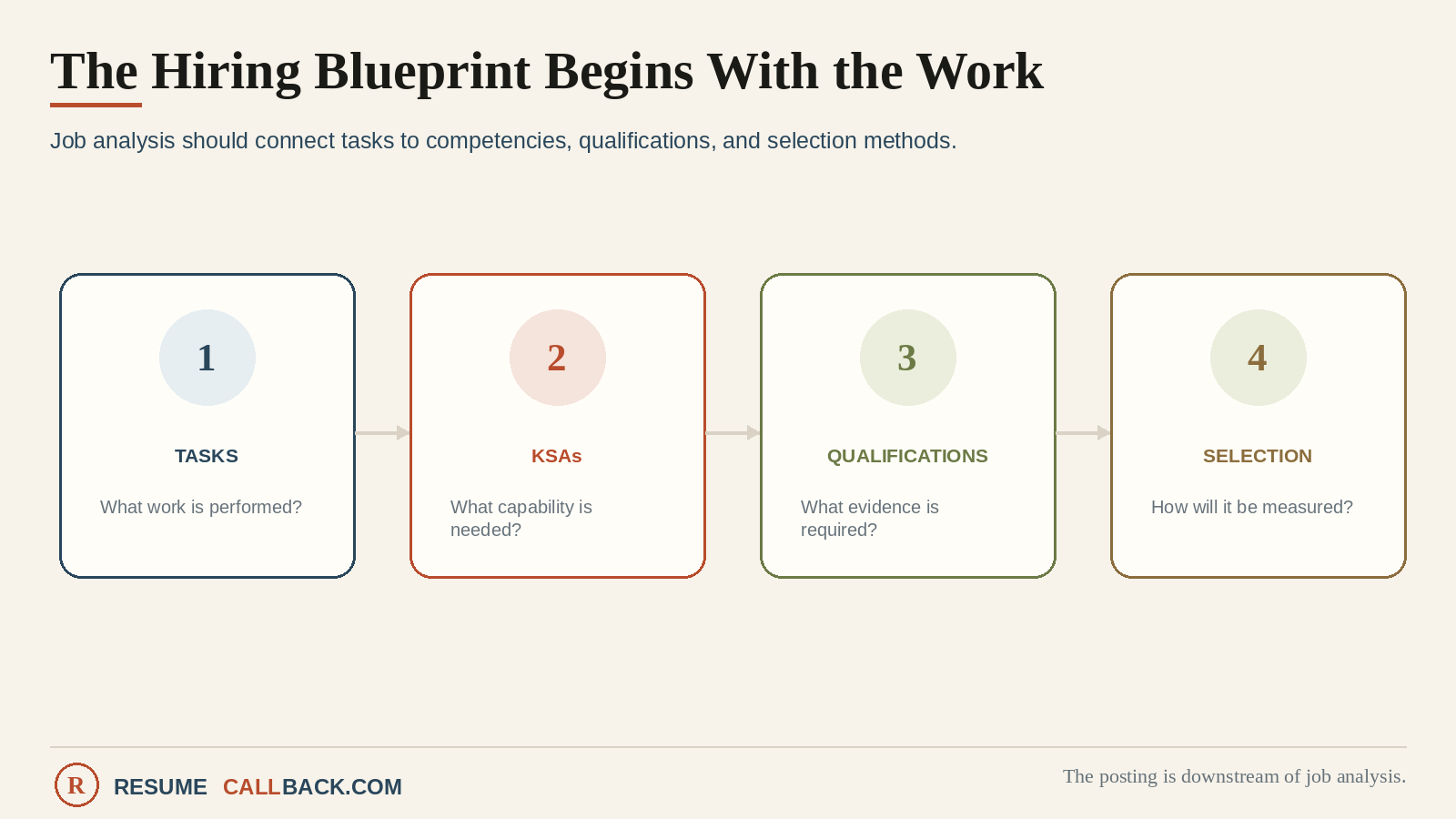
The intended logic begins with job analysis.
The U.S. Office of Personnel Management describes job analysis as a systematic process for gathering and analyzing information about the content, context, and requirements of a job. It connects the tasks performed with the competencies or KSAs required to perform them.
That connection is the hiring blueprint. It is one of the ideas that shapes the Applicant Intelligence framework — a small library on how modern hiring actually works and how candidates can respond to it deliberately.
Job analysis identifies the work
A job analysis can examine:
- Duties
- Tasks
- Responsibilities
- Work products
- Tools and systems
- Decisions
- Stakeholders
- Work environment
- Frequency
- Importance
- Difficulty
- Consequences of error
- Requirements at entry
The objective is not to write an attractive advertisement.
The objective is to understand what successful performance requires.
Tasks and competencies are connected
A task describes what the employee does.
A competency describes what the employee needs to perform the work successfully.
Example:
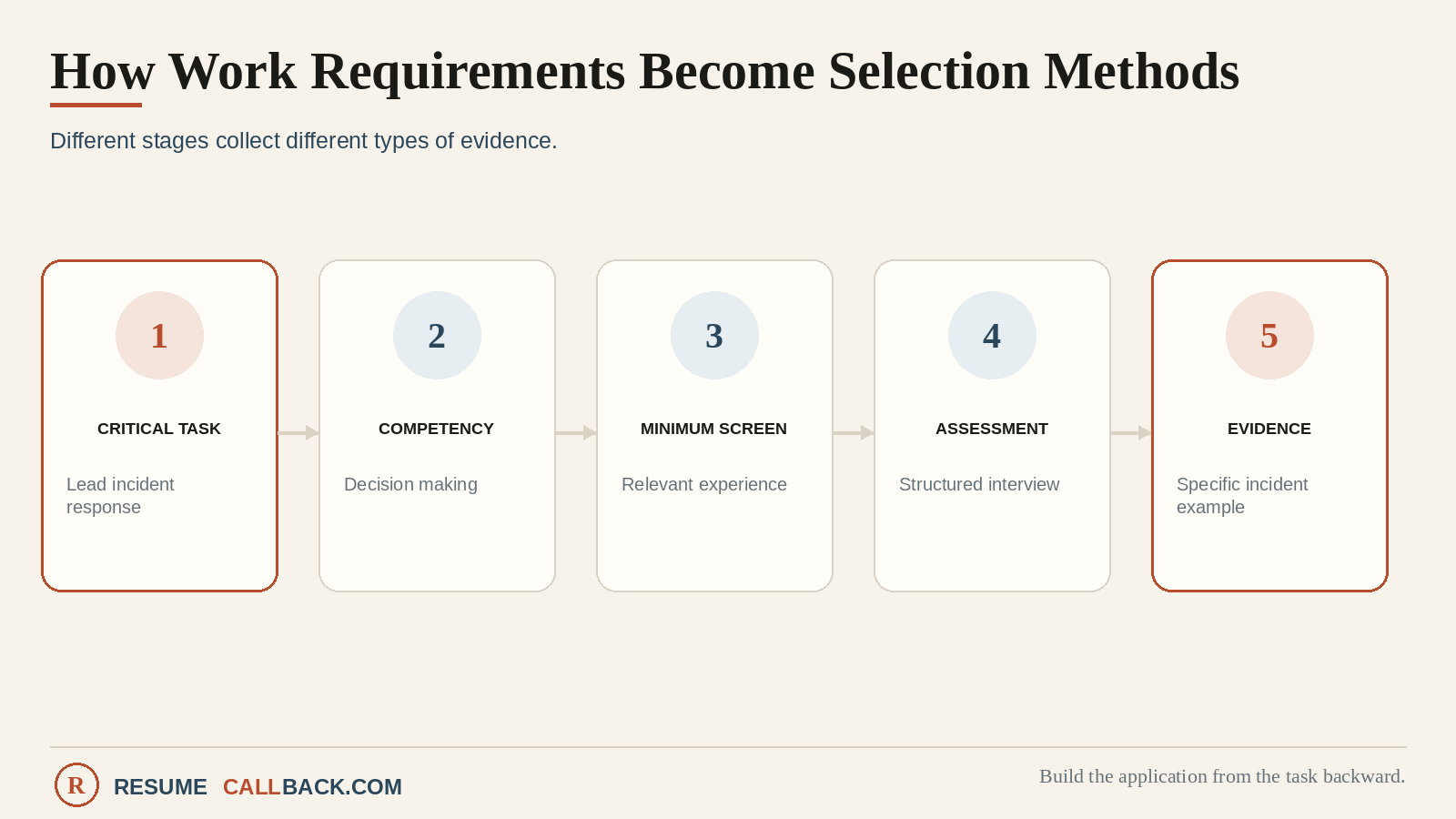
Task: Lead incident-response coordination during a cybersecurity event.
Potential competencies:
- Incident management
- Decision making
- Oral communication
- Risk assessment
- Technical competence
- Stakeholder coordination
- Attention to detail
The task is the work.
The competencies are part of the capability required to perform it.
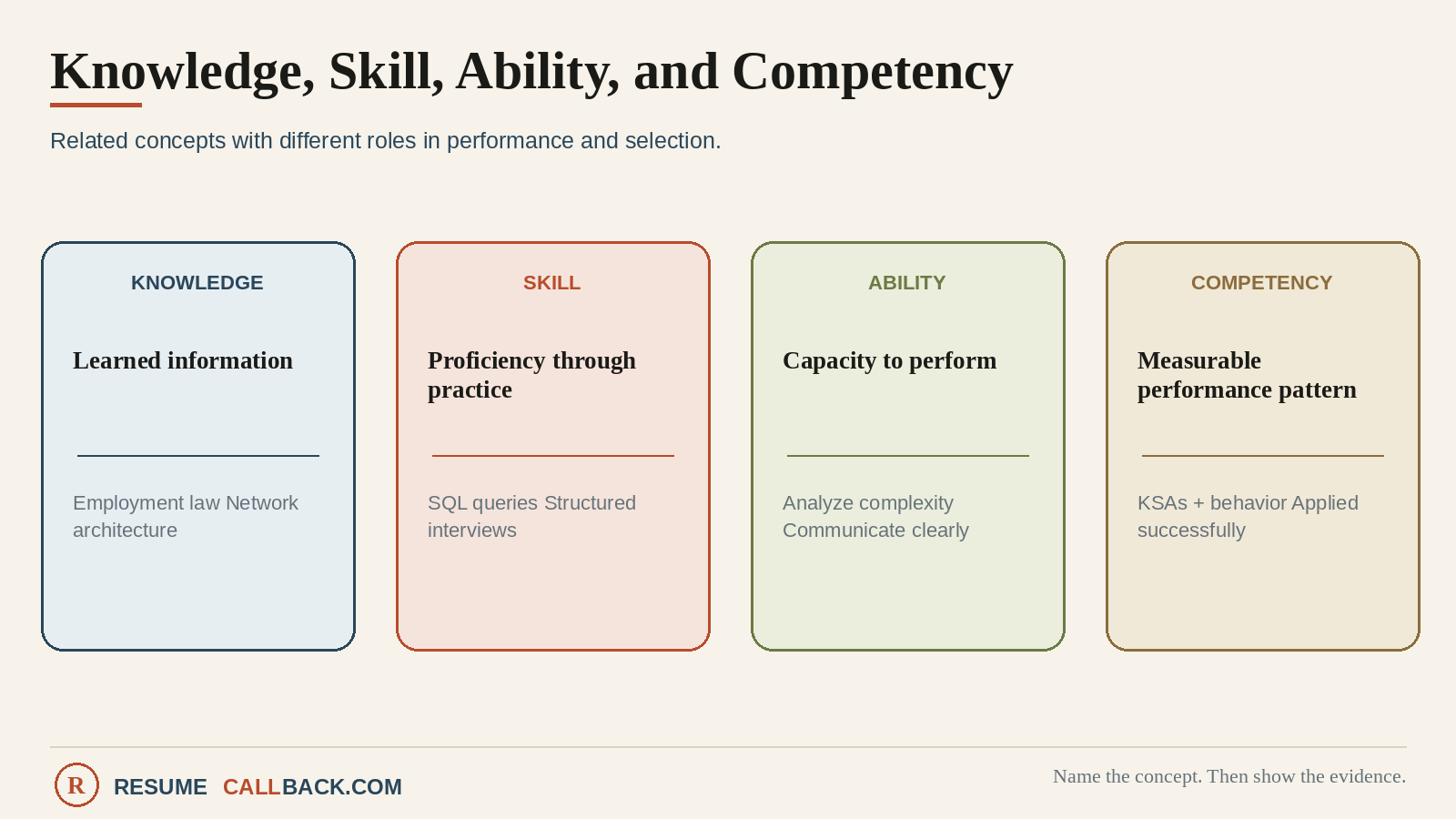
What are KSAs?
Knowledge
A body of learned information.
Examples:
- Employment law
- Network architecture
- Accounting principles
- Project-management methods
- Clinical procedures
Skill
Proficiency developed through practice.
Examples:
- Writing SQL queries
- Conducting structured interviews
- Configuring firewalls
- Building financial models
- Negotiating contracts
Ability
A capacity to perform an activity or behavior.
Examples:
- Analyze complex information
- Communicate with executives
- Prioritize competing demands
- Learn new systems
- Detect patterns
In practice, organizations may also use broader competency models that combine knowledge, skills, abilities, behaviors, and other characteristics. OPM's competency-based qualification standard for IT management is one example of that broader framing.
The job description and job specification are different
The job description generally explains the work:
- Duties
- Responsibilities
- Reporting relationship
- Scope
- Conditions
- Outcomes
The job specification describes the person-related requirements:
- Education
- Experience
- Licenses
- Skills
- Competencies
- Physical requirements
- Work authorization
- Availability
Many public postings combine both.
Candidates should still separate the two.
The description explains the work.
The specification explains the screening target. The companion piece on how to dissect a job description walks through this read section by section.
Requirements become selection methods
Once the employer identifies critical work and competencies, it chooses ways to measure them.
Selection methods may include:
- Application review
- Resume screening
- Knockout questions
- Occupational questionnaires
- Work samples
- Job-knowledge tests
- Structured interviews
- Reference checks
- Background checks
- Physical ability tests
- Credential verification
- Assessment centers
OPM's assessment and selection guidance discusses how job-analysis results can support tools such as structured interviews, occupational questionnaires, and job-knowledge tests.
The sequence matters because early methods are often designed to reduce the pool before more expensive evaluation occurs.
Minimum qualifications are not the same as best-qualified criteria
Minimum qualifications determine whether the candidate can continue.
Best-qualified criteria help distinguish among candidates who meet the minimum.
A candidate may be capable of the work and still fail a minimum screen because:
- The required evidence is missing
- The experience is described using different terminology
- The title does not make the level obvious
- A license or credential is not shown
- The employer used a rigid experience threshold
- The application answer conflicts with the resume
The applicant should not assume the reviewer will infer the missing connection.
Before your next application: Analyze your resume against a job description to see the match score, missing evidence, and rejection risks.
Experience requirements are proxies
Years of experience are often used as a proxy for exposure, complexity, and readiness.
That proxy is imperfect.
Two candidates with five years may have very different depth.
One candidate with three years may have operated at greater scale than another with eight.
The applicant cannot always change the employer's rule.
The applicant can make scale, complexity, ownership, and outcomes visible.
Screening should connect to the job
The Equal Employment Opportunity Commission advises employers to ensure tests and selection procedures are properly validated for the positions and purposes for which they are used and are job-related. The EEOC's questions and answers on the Uniform Guidelines elaborates on how validation is expected to work in practice.
That matters because a selection method can be consistent without measuring the correct thing.
A difficult test is not automatically a valid test.
A detailed interview is not automatically a structured or reliable interview.
A keyword screen is not automatically a good measure of job performance.
Validity and reliability
Reliability
Does the method produce reasonably consistent results?
Validity
Does the method measure or predict what it is supposed to measure?
A screen can be reliable and still be invalid.
For example, a rigid title filter may consistently remove candidates whose titles differ from the market title. Consistency does not prove that the filter identifies who can perform the work. The companion piece on whether the person screening your resume is qualified to filter you out covers this from the applicant's side.
Why candidates should care
Understanding the blueprint changes application strategy.
The candidate should ask:
- What tasks appear critical?
- Which KSAs or competencies support those tasks?
- Which qualifications are likely minimum screens?
- Which accomplishments prove the competencies?
- Which evidence will matter later in interviews?
- Where could the process misread my background?
Build the application from the task backward
Instead of copying keywords:
- Identify the task.
- Identify the likely competency.
- Select a truthful example.
- State your action.
- Show scale.
- Show the result.
That produces evidence capable of surviving several stages of review.
The hiring blueprint is imperfect
Real organizations do not always execute this process cleanly.
Job descriptions may be copied.
Requirements may be inflated.
Screening questions may be disconnected from the work.
Hiring managers and recruiters may disagree.
The framework still matters because it explains what a defensible system is trying to do — and where poor implementation creates applicant risk.
Before You Enter the Selection Process
ResumeCallback helps candidates compare the resume with the job description, identify likely screening criteria, and map job requirements to visible evidence. The job description names the work. The job specification defines the candidate. The selection process decides what evidence counts.