Indeed Disposition Sync: What Happens After You Apply
Indeed's Disposition Sync API allows ATS partners to send application status changes to Indeed. Learn what is documented, what it may mean, and what remains unproven.
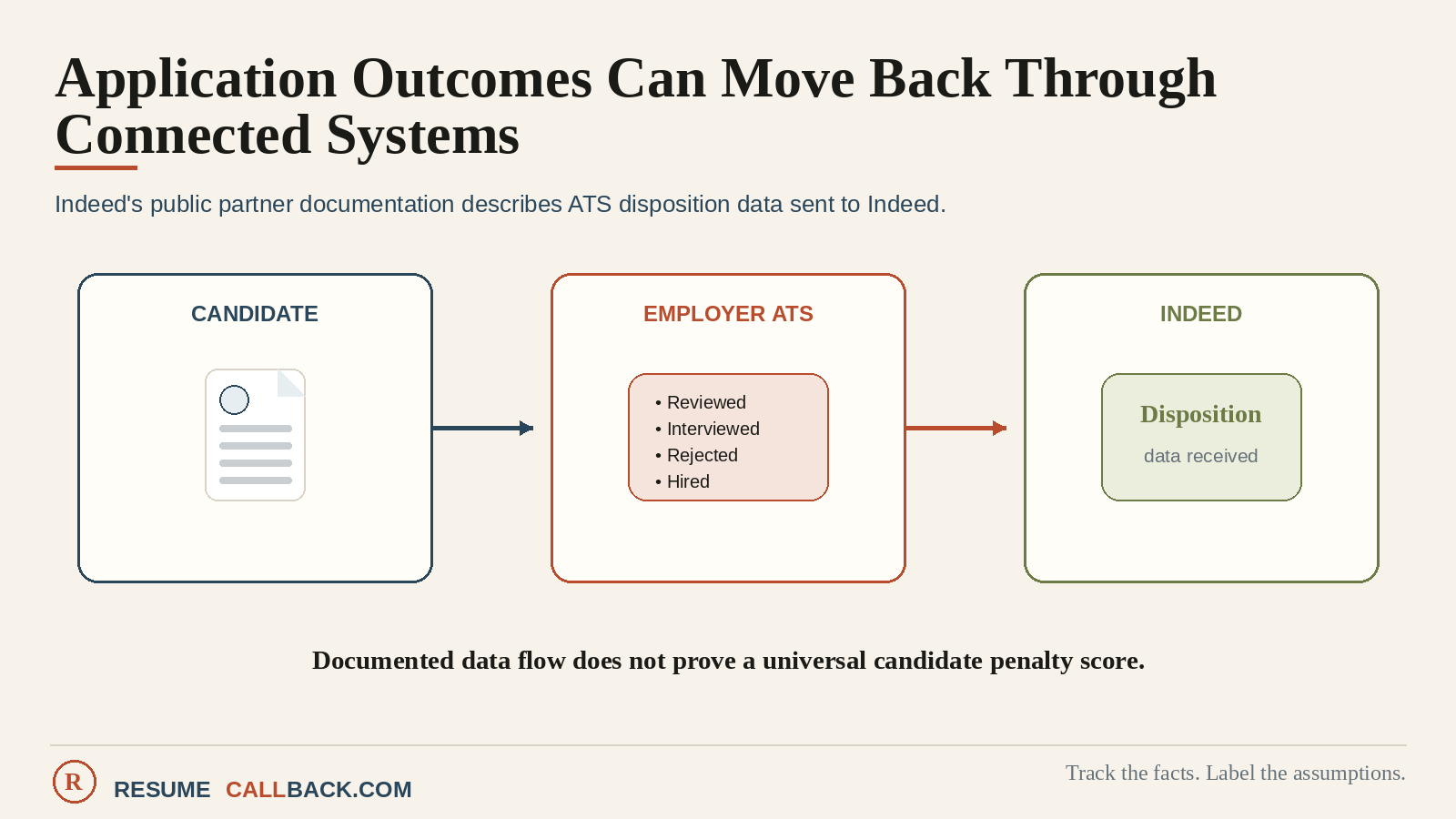
Most candidates think about job platforms as one-way systems.
A job appears. The candidate applies. The application leaves the platform and enters the employer's process.
Indeed's public partner documentation shows that, in some integrations, information can also move back.
Indeed's Disposition Sync API allows applicant-tracking-system partners to send application disposition data to Indeed for Indeed Apply and, under the applicable integration, certain non-Indeed Apply jobs. Indeed describes disposition data as updates made after a candidate applies and states that these updates can track stages from the initial application through final disposition.
That documented capability matters.
It does not prove every theory circulating about applicant scoring.
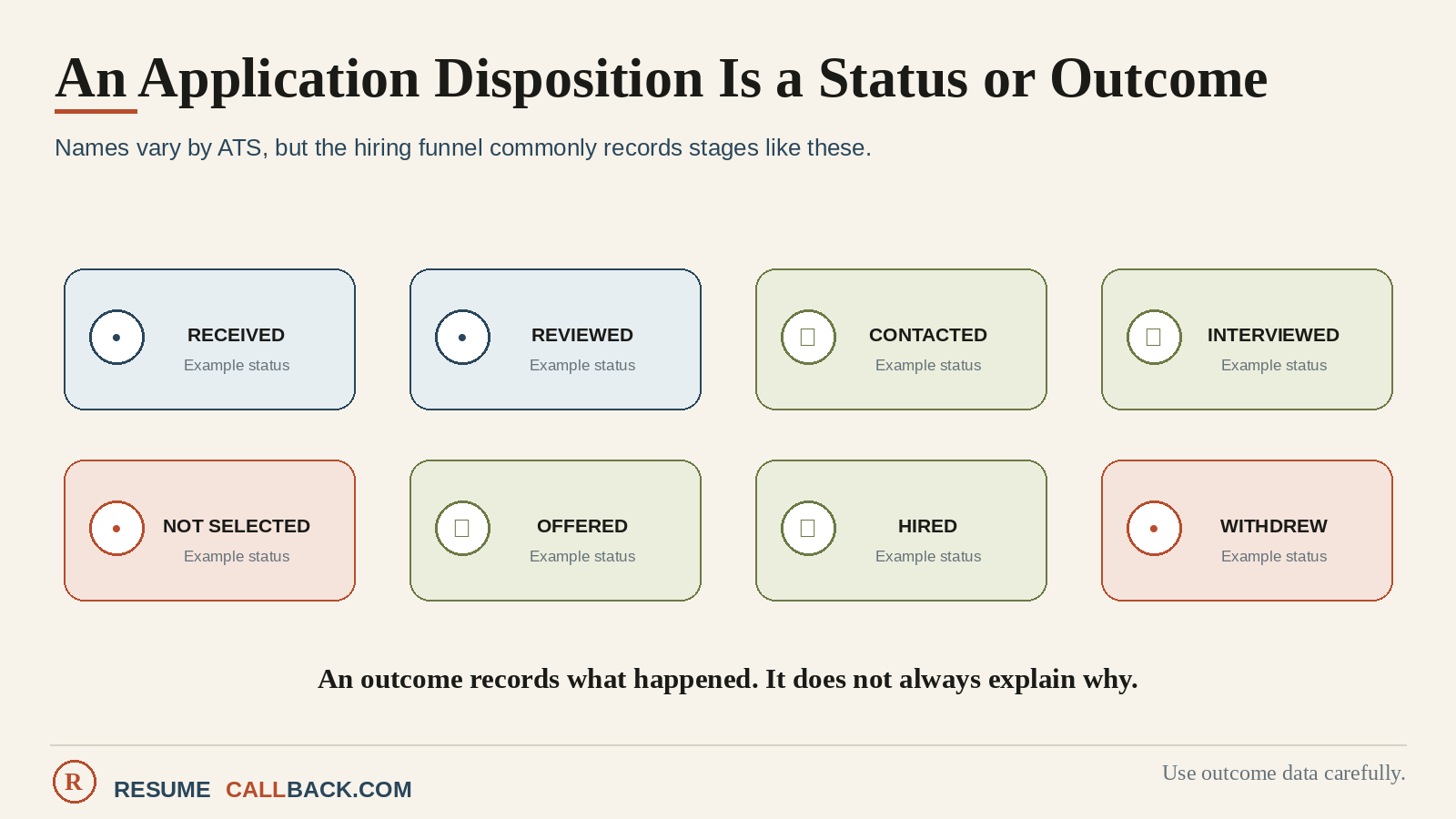
What a disposition is
In recruiting, a disposition is a status or outcome attached to an application.
Examples can include:
- Application received
- Reviewed
- Contacted
- Interviewed
- Rejected or not selected
- Offer made
- Hired
- Candidate withdrew
Exact status names vary by ATS and integration.
Indeed's legal documentation for disposition data defines it as an outcome or status change from an employer's interaction with an applicant, associated with an application identifier and a timestamp. The documentation specifically includes whether the applicant was hired or not hired.
What the API does
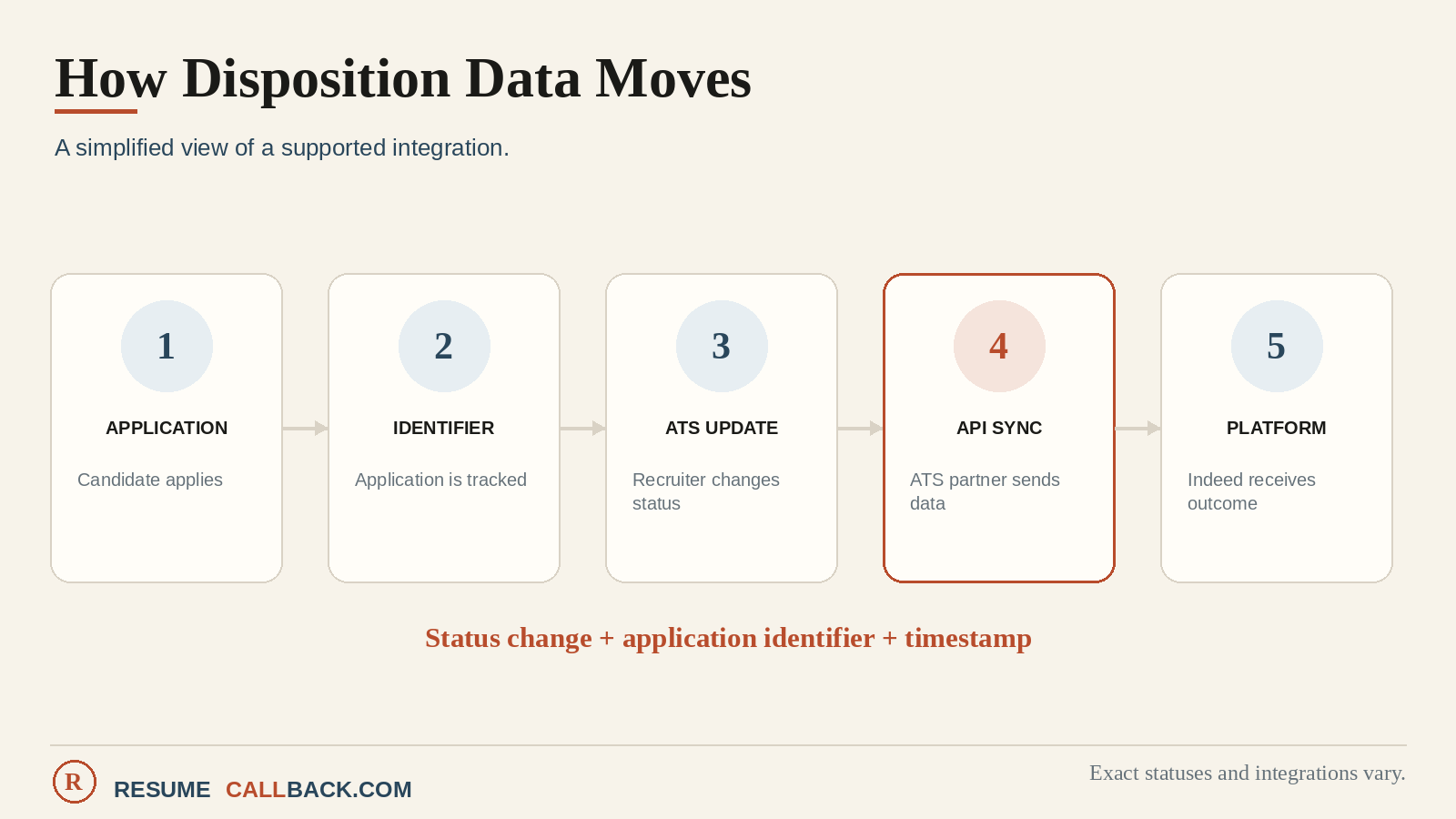
The Disposition Sync API is designed for ATS partners.
At a high level:
- A candidate applies.
- The application is identified.
- The employer or recruiter updates the candidate's status in the ATS.
- The ATS integration sends supported disposition data to Indeed.
- Indeed receives the application outcome and timestamp.
Indeed's documentation states that the API can support Indeed Apply and non-Indeed Apply jobs under the applicable integration.
This means the outcome of an application may not remain only inside the employer's ATS in workflows that use the integration.
Why Indeed wants the data
Indeed states that it uses disposition data to improve the job-search experience for candidates and provide insights to employers.
The exact models, weightings, and downstream decisions are not publicly detailed in the API documentation.
Reasonable uses could include measuring application quality, employer responsiveness, job-posting performance, funnel conversion, or matching effectiveness. Those are interpretations, not confirmed descriptions of every internal use.
The disciplined conclusion is:
Indeed receives structured information about what happened to applications in supported integrations.
The undisciplined conclusion is:
Indeed has confirmed that every rejection lowers a universal candidate score.
The first statement is documented. The second is not.
What the documentation supports
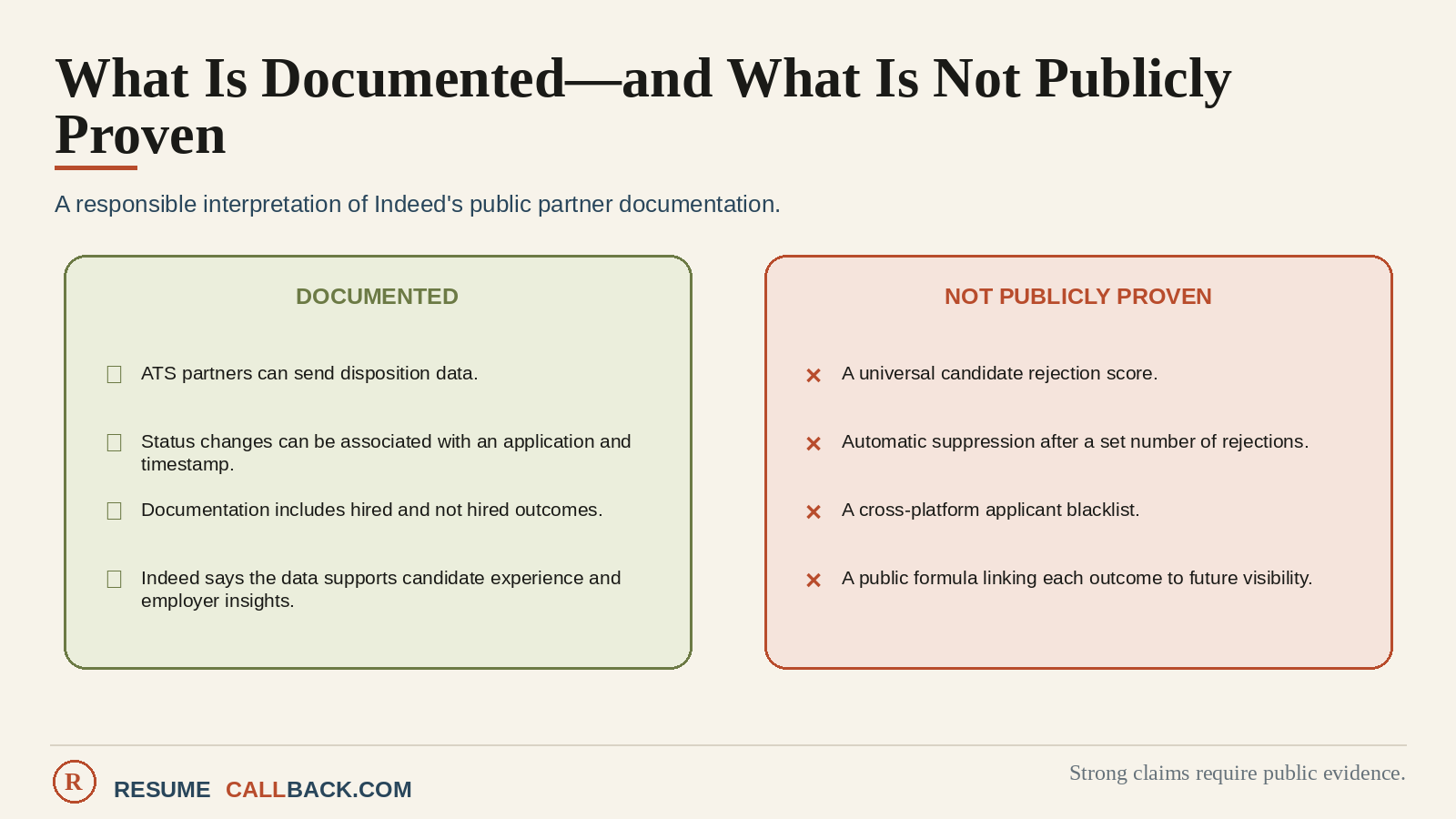
Public Indeed documentation supports these statements:
- ATS partners can send disposition data to Indeed.
- Data can apply to Indeed Apply and certain non-Indeed Apply jobs under the applicable integration.
- Disposition data includes status changes after an application.
- The data is associated with an application identifier and timestamp.
- Outcomes can include hired and not hired.
- Indeed says it uses the data to improve candidate experience and employer insights.
Before your next application: Analyze your resume against a job description to see the match score, missing evidence, and rejection risks.
What is not publicly proven
The documentation reviewed does not establish:
- A universal candidate rejection score
- A guaranteed penalty for high application volume
- A rule that repeated rejections suppress every future application
- A cross-platform blacklist shared among all job sites
- A public formula showing how outcomes affect ranking
- That every employer or ATS participates
- That every application status is accurate or consistently updated
Those distinctions should remain visible in any responsible article or LinkedIn post.
Why this still changes applicant strategy
The absence of a proven penalty does not make application quality irrelevant.
Disposition data allows platforms to observe outcomes at scale. Recruiting systems increasingly use data to improve matching, recommendations, employer analytics, and workflow decisions.
A candidate cannot control the platform's internal models. A candidate can control whether applications are credible and whether the resume clearly communicates the fit. That is the same case for controlled application selection we make in Spray and Pray Is Not a Job-Search Strategy.
That is enough reason to reject blind volume as the primary strategy.
The risk of misreading the data
Disposition records reflect application outcomes, but they do not always explain why the outcome occurred.
A candidate can be rejected because:
- Another applicant was stronger
- An internal candidate was selected
- The role was paused
- Compensation changed
- The employer changed requirements
- The resume failed to demonstrate fit
- A required qualification was missing
- The candidate applied too late
- The employer never completed the workflow correctly
Outcome data is useful. It is not a perfect explanation of candidate quality.
This is another reason to avoid overstated claims.
What applicants should do
Apply selectively
Do not treat every remotely related job as a credible opportunity.
Read the entire posting
Identify central requirements, mandatory constraints, and employer priorities.
Align the resume
Make the relevant evidence visible. Use accurate language and measurable outcomes. The mechanics of building a resume that can hold up to related but non-interchangeable roles are covered in Why One Generic Resume Cannot Match Every Related Role.
Track conversion
Measure response and interview rates by role family and resume foundation.
Avoid repeated weak submissions
If a strategy produces hundreds of applications and almost no response, do not answer only by increasing volume. Diagnose the match, positioning, and selection process.
Apply directly when practical
A direct employer application does not guarantee a different data path, but it can reduce dependence on one-click application behavior and can place the candidate in the employer's intended workflow.
The larger lesson
Disposition Sync is one example of how hiring data moves through connected systems.
Candidates should stop assuming that every application is an isolated document dropped into a black box.
At the same time, they should resist unsupported claims about secret punishment algorithms.
The credible position is stronger:
- Outcomes can be recorded.
- Outcomes can be exchanged.
- Platforms use outcome data to improve their systems.
- The full scoring logic is not public.
- Stronger application selection and clearer alignment remain rational regardless of the undisclosed model.
Every application consumes time and creates an outcome. The objective should not be to produce the highest possible count. It should be to produce the highest number of credible opportunities and learn from the conversion pattern.
Before You Submit Your Next Application
ResumeCallback helps candidates compare a resume with the actual job description, identify rejection risks, and improve the evidence before submission. Apply with intent — not with assumptions.