Is the Person Screening Your Resume Actually Qualified to Filter You Out?
Learn why qualified candidates can be eliminated during initial screening and how to make job-related evidence easier to recognize.
One of the most frustrating parts of the modern job search is that a resume may be eliminated before it reaches someone who understands the candidate's work.
That does not mean every recruiter is unqualified.
It means the first screen often has a different purpose from the hiring manager's review.
The screener may be checking:
- Minimum qualifications
- Required credentials
- Location
- Compensation
- Work authorization
- Job-title alignment
- Years of experience
- Screening-question answers
- Evidence of specific competencies
- Obvious rejection risks
That process can be necessary.
It can also eliminate valid candidates when the criteria, evidence, or reviewer understanding are weak.
This piece is part of the Applicant Intelligence framework — a small library on how modern hiring actually works and how candidates can respond to it deliberately.
Screening is designed to reduce volume
Large applicant pools require triage.
Early screening methods are usually lower-cost and faster than technical interviews, work samples, or panel evaluations.
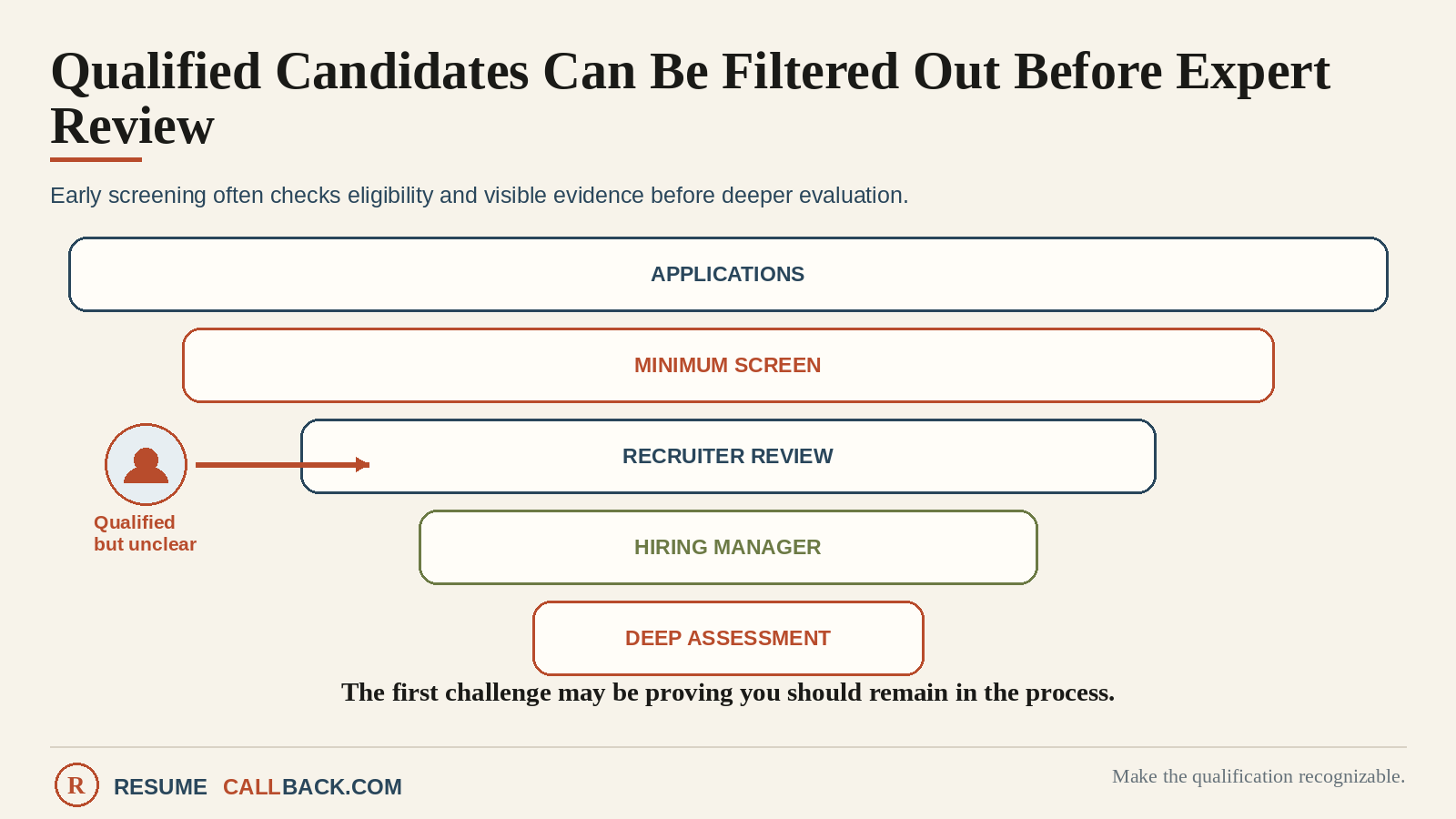
The funnel may begin with:
- Application questions
- Automated or recruiter filters
- Resume review
- Recruiter screen
- Hiring-manager review
- Technical or functional assessment
- Interviews
- References and checks
- Offer decision
The candidate's first challenge is not always proving they are the best person.
It is proving they should remain in the process.
A recruiter and hiring manager see different evidence
A recruiter may understand:
- Hiring process
- Compensation
- Candidate communication
- Sourcing
- Market availability
- Minimum qualifications
- Organizational fit
A hiring manager or subject-matter expert may better understand:
- Technical depth
- Adjacent experience
- Transferable skills
- Scale
- Complexity
- Industry nuance
- Performance evidence
The risk appears when the initial application requires subject-matter interpretation but the process does not provide it.
Nontraditional candidates are vulnerable
Candidates are easier to misread when they have:
- Internal titles that differ from market titles
- Broad leadership experience
- Military experience
- Consulting backgrounds
- Career changes
- Older relevant experience
- Work across several related disciplines
- Responsibilities larger than the official title suggests
- Accomplishments described in company-specific language
The more translation the application requires, the more likely the first review can miss the match.
The job analysis should define the screen
OPM explains that job analysis identifies critical tasks and competencies and can be used to develop assessment tools.
A strong screening process therefore begins with:
- Current understanding of the job
- Input from knowledgeable subject-matter experts
- Clear minimum qualifications
- Observable competency definitions
- Selection methods linked to the work
- Documentation of the connection
When that foundation is weak, the screen may measure convenience instead of capability. The companion piece on job analysis, KSAs, and candidate screening walks through what a defensible screen is trying to do.
How valid candidates get filtered out
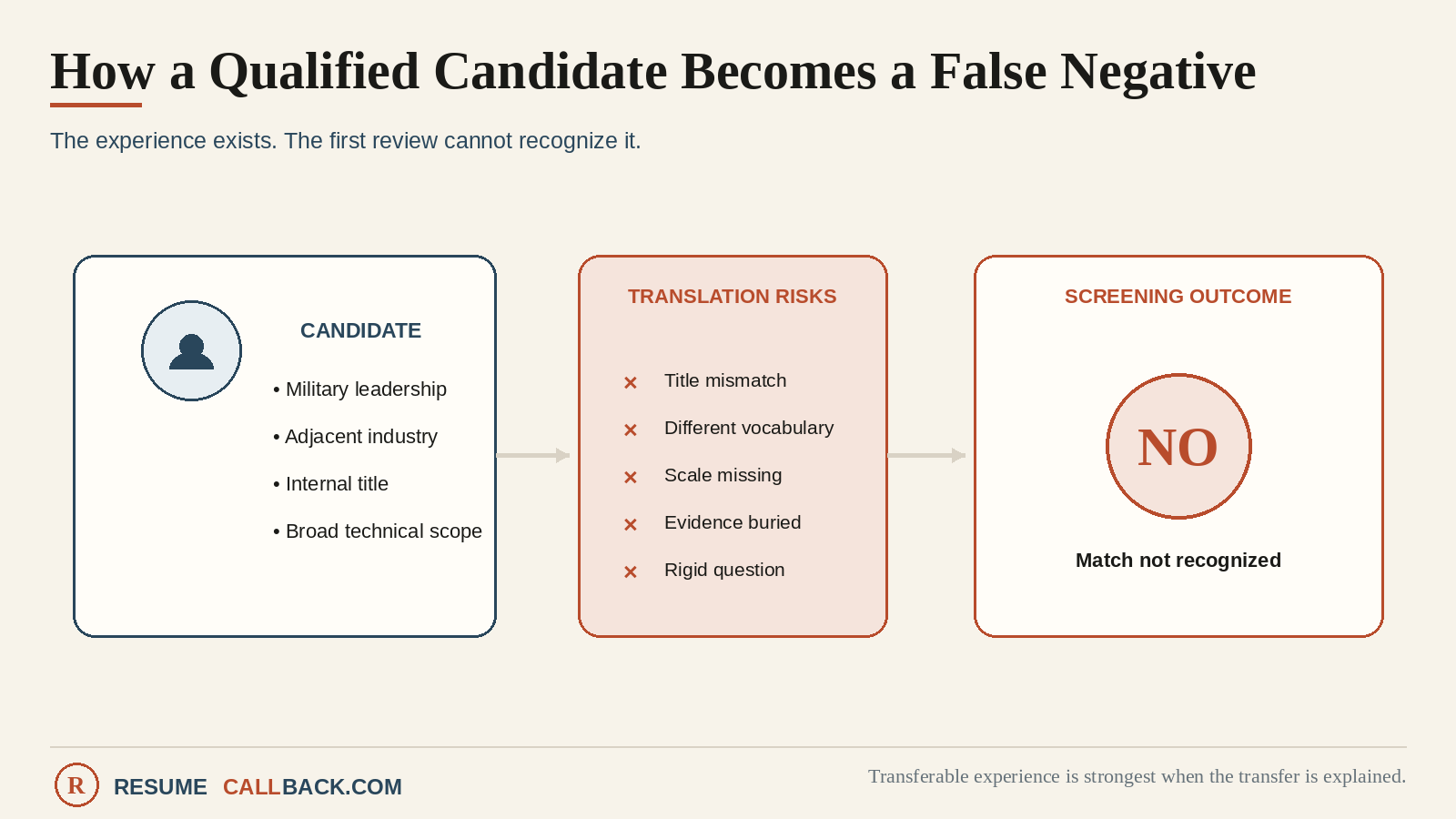
Title mismatch
The candidate performed director-level work under a manager title.
Vocabulary mismatch
The company used one technical term while the candidate used another.
Scale is missing
The resume states responsibility without showing users, sites, budget, team size, or complexity.
Transferable skill is buried
The candidate has the capability in another industry or function.
Requirement is overstated
The posting lists a preferred technology as mandatory.
Screener question is too rigid
A yes-or-no response cannot capture adjacent expertise.
Resume narrative is too broad
The candidate looks experienced but not clearly aligned.
Evidence appears too late
The relevant accomplishment is on page two or in an older role.
Before your next application: Analyze your resume against a job description to see the match score, missing evidence, and rejection risks.
Reliability does not guarantee correctness
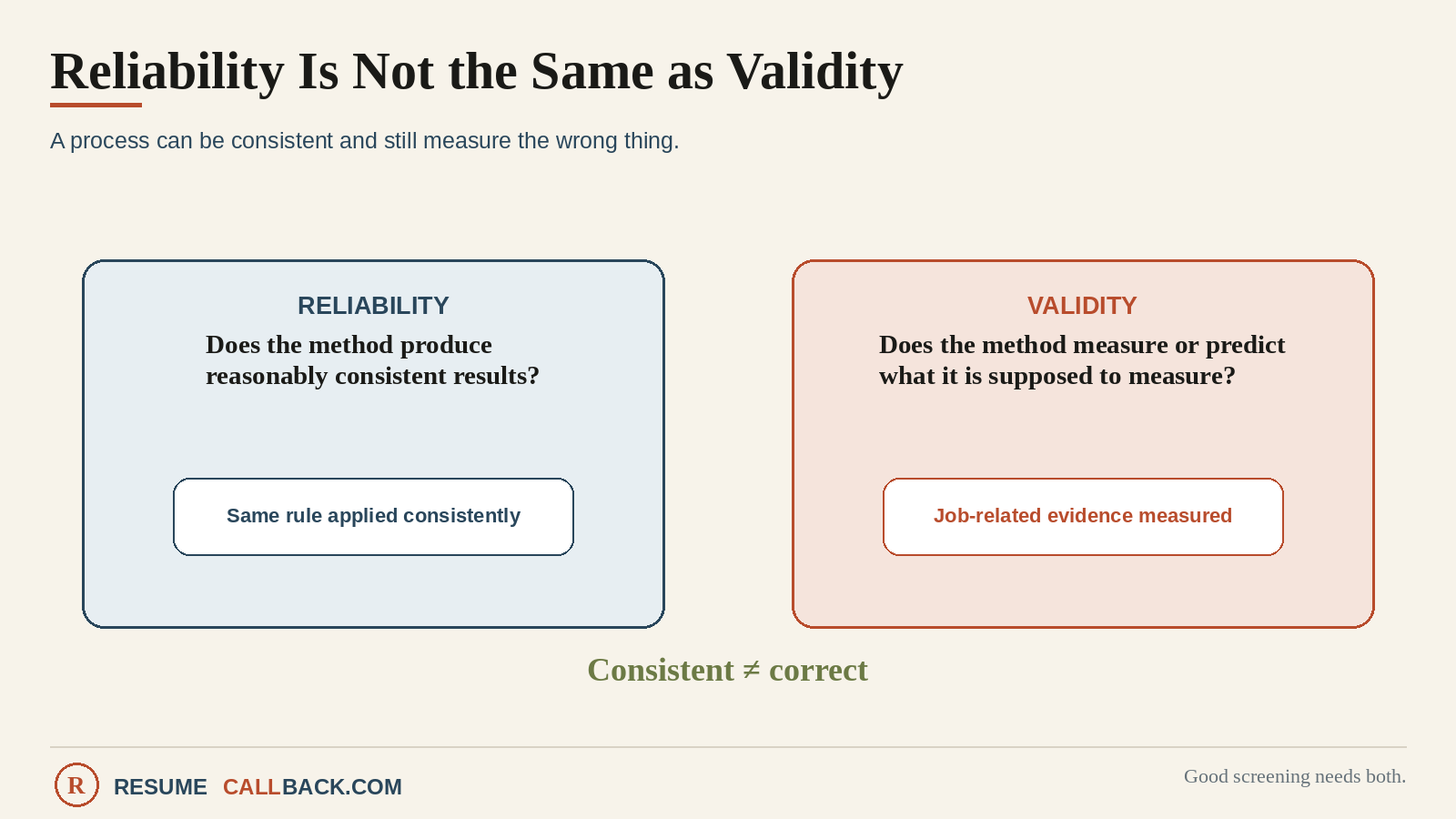
A process can consistently apply the same rule and still measure the wrong thing.
That is the difference between reliability and validity. The EEOC's guidance on employment tests and selection procedures discusses the expectation that selection methods be properly validated and job-related.
A title filter may be reliable.
It may still be a poor measure of whether the candidate can perform the work.
A certification screen may be appropriate for a regulated role.
It may be less appropriate when the certification is simply a hiring preference disconnected from actual job performance.
The candidate usually cannot redesign the process.
The candidate can reduce unnecessary ambiguity.
Make the evidence easier to recognize
Clarify the target role
Use a headline and summary that establish the lane.
Translate internal titles
Keep the official title accurate, then add a clarifying market equivalent when appropriate.
Lead with relevant outcomes
Do not bury the reason you qualify.
Show scale
Use team size, budget, sites, customers, systems, transactions, or risk.
Connect adjacent experience
Explain the bridge rather than expecting the reviewer to infer it.
Match accurate terminology
Use the employer's language when it truthfully describes your work. Reading the posting for repeated priorities, verbs, and required outcomes is covered in the companion piece on how to dissect a job description.
Resolve contradictions
The resume, LinkedIn profile, and screening answers should not tell incompatible stories.
The candidate should also screen the employer
A poor screening process is information.
Warning signs include:
- Interviewers who have not read the resume
- Repeated contradictory requirements
- No clear ownership of the hiring decision
- Assessments unrelated to the work
- Excessive unpaid assignments
- Constant changes in role scope
- Refusal to explain the process
- Disrespectful or disorganized communication
The candidate is not powerless.
The hiring process is also evidence about the employer.
Do not attack recruiters — improve the handoff
The objective is not to blame recruiters.
It is to recognize that different reviewers possess different information and operate under different constraints.
A strong application performs the handoff.
It makes the central qualifications visible enough for the initial reviewer and detailed enough for the subject-matter expert.
The practical question
Before applying, ask:
Could someone who is not an expert in my field understand why I meet the central requirements?
If not, the application is carrying unnecessary risk.
Make the Match Recognizable
ResumeCallback helps candidates identify where the resume requires too much interpretation, where the evidence is weak or buried, and which rejection risks should be addressed before submission. A qualified candidate can still be filtered out when the application fails to make the qualification recognizable.